
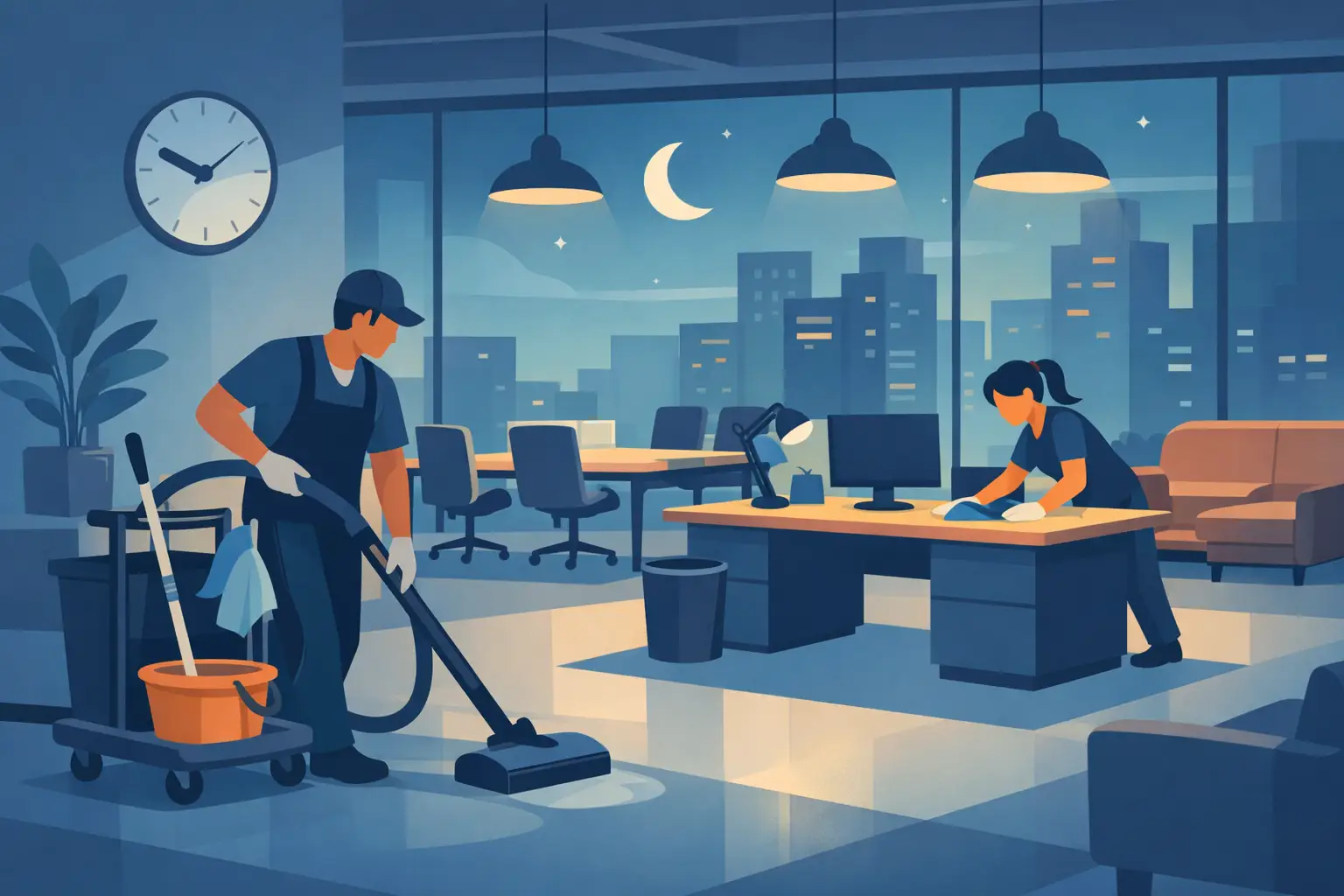

At 8:30 a.m., your office should be ready for work, not recovering from it. Desks should be dust-free, restrooms stocked, trash removed, and common areas presentable before employees, clients, or tenants arrive. That is why after hours office cleaning is not just a convenience for many businesses. It is an operational decision that protects productivity, appearance, and hygiene without interrupting the workday.
For offices of any size, cleaning during business hours creates trade-offs. Vacuum noise competes with calls. Restroom servicing interferes with traffic. Floor care becomes harder to manage safely when staff and visitors are moving through the space. In contrast, a well-run after-hours program allows cleaning crews to work more thoroughly, with fewer obstacles and less disruption to the people using the building.
Why after hours office cleaning makes operational sense
Most office environments run on routines. Teams arrive, meetings begin, deliveries come in, and shared spaces see constant use. Cleaning in the middle of that flow can slow things down or force shortcuts. A cleaner may skip a conference room because it is occupied, delay hard floor work until traffic clears, or rush through a kitchenette before the next break.
After hours office cleaning changes those conditions. When the building is quieter, crews can clean more consistently and with better access to desks, floors, glass, restrooms, reception areas, and breakrooms. The result is usually a higher standard of execution, especially in spaces where visible cleanliness matters to staff morale and visitor perception.
There is also a safety benefit. Wet floors, cleaning carts, extension cords, and supply transport are easier to manage when foot traffic is low. That matters for corporate offices, medical administration spaces, schools, and multi-tenant properties where risk management is part of daily operations.
What a quality after-hours program should include
Not every office needs the same service level. A professional services firm with light traffic will have different needs than a call center, a clinic office, or a shared workspace with heavy daily use. The right cleaning plan should reflect that reality.
In most office settings, after-hours service includes trash removal, restroom cleaning and restocking, dusting of horizontal surfaces, vacuuming carpeted areas, mopping hard floors, cleaning entrance glass, wiping touchpoints, and maintaining kitchens or breakrooms. Some facilities also require periodic deep cleaning, interior glass detailing, carpet care, floor refinishing, or disinfection support depending on use patterns and health expectations.
The key is consistency. A cleaning checklist is useful, but it is only part of the picture. What matters more is whether the provider understands your building layout, occupancy patterns, access protocols, and priority areas. A front lobby may need attention every visit because it shapes first impressions. A training room used twice a week may not. An executive suite may require more detailed dusting than a back-office workspace. Good service planning accounts for those differences instead of applying the same routine to every square foot.
After hours office cleaning and employee experience
Office cleanliness affects more than appearance. It influences how employees experience the workplace every day. Overflowing trash, stained restroom counters, dusty vents, and neglected kitchen areas send a message, even when no one says it out loud. People notice when the environment feels maintained, and they notice when it does not.
This is one reason after-hours service works well for occupied office environments. Staff arrive to a space that feels reset. Restrooms are in order. Shared surfaces look clean. Meeting rooms are ready. That quiet reliability supports the workday without becoming part of it.
It also reduces friction between cleaning activity and employee focus. In offices where calls, video meetings, and client visits are routine, daytime cleaning can be distracting. Some businesses try to work around this by limiting daytime service to the bare minimum, but that can lead to inconsistent results. A scheduled evening program is often the better balance.
Choosing a provider for after hours office cleaning
If you are evaluating vendors, the biggest question is not whether they offer evening service. Many do. The better question is whether they can deliver after-hours cleaning with the same accountability you would expect during the day.
That starts with staffing. Crews working after business hours need to be trained, insured, and clear on site-specific procedures. They may be entering secured areas, working around confidential materials, setting alarms, or following detailed building access instructions. Reliability matters more at night because fewer people are on site to catch problems in real time.
Communication matters just as much. Facility managers and office administrators need a cleaning partner who can document work, respond to issues, and adjust service when occupancy changes. If your office has seasonal traffic swings, tenant turnover, renovation work, or special events, the cleaning plan should be able to adapt without confusion.
This is where customized service becomes important. A generic package may sound efficient, but offices rarely operate in generic conditions. A law office, a tech company, and a medical administrative office can all occupy similar square footage while requiring very different cleaning priorities. Pristine Maintenance and Services approaches facilities with that operational mindset, which is often what separates dependable commercial cleaning from basic janitorial coverage.
What to ask before starting service
A strong after-hours program begins with clear expectations. Before service starts, building decision-makers should understand who is coming on site, when they are scheduled, what tasks are included, and how quality will be monitored.
It is worth asking how keys, alarm codes, and entry permissions are handled. You should also ask how the provider manages missed service, emergency requests, consumable restocking, and issues reported by staff. For larger offices or managed properties, inspection processes and account oversight are especially important. If there is no clear line of responsibility, small cleaning issues tend to turn into larger service problems over time.
Frequency is another area where it depends. Some offices need five-night-per-week service because of headcount, public traffic, or restroom use. Others can maintain standards with three evenings per week plus periodic detail work. There is no single correct schedule. The right one depends on occupancy, layout, flooring, shared amenities, and the image the business needs to maintain.
Common mistakes businesses make
One common mistake is buying strictly on price. Cost matters, but low pricing often shows up somewhere else – rushed visits, inconsistent staffing, weak supervision, or tasks quietly falling off the schedule. Office cleaning is a recurring operational service. If execution is unreliable, your team ends up managing the gap.
Another mistake is under-scoping the work. Businesses sometimes request basic nightly cleaning but overlook high-touch areas, breakroom buildup, restroom supply management, or periodic detail cleaning. At first, the space looks acceptable. After a few months, however, grime accumulates in corners, on baseboards, around fixtures, and in shared spaces that need more than surface-level attention.
The third mistake is failing to align service with actual building use. A hybrid office, for example, may need less desk-area cleaning on some nights but more attention in collaboration zones and restrooms on peak attendance days. Cleaning plans should reflect how people use the space now, not how they used it three years ago.
When after-hours service is the right fit
After-hours office cleaning is usually the right choice when your workplace has steady daytime activity, client-facing areas, shared kitchens, frequent meetings, or security and safety concerns tied to occupied cleaning. It is also a strong fit for multi-tenant office buildings, professional suites, administrative facilities, and any environment where the workday should begin in a clean, orderly setting.
That said, some businesses still benefit from a blended model. A daytime porter may handle immediate needs such as spill response, lobby touch-ups, or restroom checks, while the main cleaning happens after hours. For larger facilities, that combination often provides the best overall coverage. The point is not to force every building into the same schedule. The point is to match service delivery to building operations.
Clean offices do not happen by accident. They come from a service plan that fits the space, the schedule, and the standards behind it. When after-hours cleaning is organized properly, your team sees the result every morning without having to think about how it got done.


0 Comments