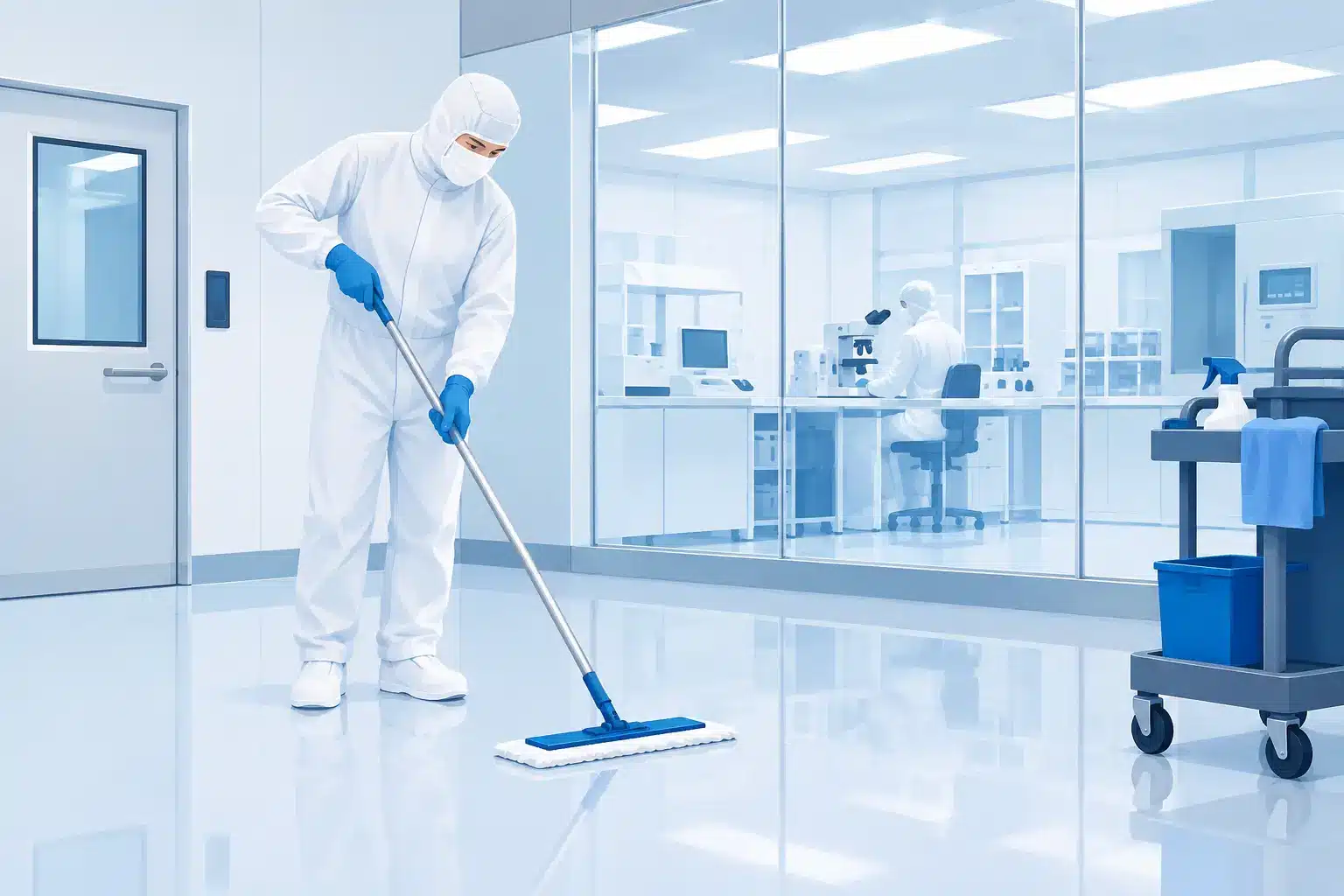

A cleanroom can look spotless and still fail its purpose. A stray fiber, dried residue on a work surface, poorly maintained floor edge, or the wrong cleaning cloth can introduce contamination that affects product quality, test results, compliance, and production schedules. Cleanroom cleaning is not ordinary commercial cleaning performed in a more sensitive room. It is a controlled process built around the specific contamination risks of the space.
For facility managers and operations leaders, the objective is clear: maintain the required environmental condition without interrupting critical work or introducing new risk. That calls for a cleaning program that accounts for room classification, processes performed inside the area, traffic patterns, approved materials, and the requirements of the organization’s quality system.
What makes cleanroom cleaning different?
Standard janitorial work focuses on appearance, general hygiene, and safe daily use. Those outcomes matter in every facility, but a cleanroom has additional controls. The concern is often not visible dirt. It may be airborne particles, fibers, skin cells, oils, chemical residues, microorganisms, or contaminants transferred from tools and packaging.
A cleaning team must understand how its work affects the environment. Improper mopping can redistribute particles. A vacuum without appropriate filtration can release contaminants back into the air. Fragranced chemicals, shedding wipes, and unapproved disinfectants may leave residues or create compatibility issues with sensitive equipment and surfaces.
The right approach depends on the facility. A medical device assembly area, pharmaceutical support space, electronics manufacturing room, laboratory, and food production environment may all use controlled cleaning practices, yet their procedures and acceptable materials can differ significantly. A cleaning plan should follow the site’s written requirements rather than rely on a generic checklist.
Start with the room’s contamination risks
Before assigning a schedule or selecting supplies, identify what the cleanroom is protecting. Is the primary concern particulate control, microbial control, chemical residue, electrostatic discharge, or a combination of these factors? The answer determines how cleaning should be performed and documented.
A practical site assessment considers the cleanroom classification or internal standard, room layout, equipment, floor and wall finishes, access points, shift schedules, and nearby operations. It should also identify high-touch and high-transfer areas, such as pass-throughs, door handles, gowning areas, carts, material staging locations, and floor transitions.
Traffic is often a major variable. A controlled room with limited entry may need a different routine than one supporting multiple production shifts. Increased movement brings more opportunities for particles and contaminants to enter, especially around doors, footwear controls, packaging transfer points, and waste handling areas.
Cleaning frequency should reflect that exposure. Some tasks may be required between shifts or before a production run, while others may be weekly or performed according to validated maintenance intervals. More frequent cleaning is not automatically better if it introduces unnecessary activity into a controlled space. The goal is appropriate control, not disruption for its own sake.
A cleanroom cleaning program needs written procedures
Consistency is one of the strongest protections against contamination. Written standard operating procedures establish what is cleaned, in what order, with which materials, at what frequency, and by whom. They also define what to do when conditions fall outside the expected standard.
A well-designed procedure generally addresses entry requirements, gowning expectations, approved equipment, chemical dilution, cleaning direction, waste removal, and documentation. Cleaning commonly follows a top-to-bottom and clean-to-less-clean sequence so contaminants are not moved onto already cleaned surfaces. The exact process should be based on the facility’s protocols and applicable regulatory expectations.
Color coding and dedicated tools can help prevent cross-contamination when used consistently. Mop heads, wipes, buckets, and carts should be suitable for the environment and stored in a way that preserves their cleanliness. Reusable tools require a defined laundering, inspection, and replacement process. Disposable materials can reduce some handling risks, but they still need to be compatible with the room and managed properly as waste.
Staff training matters as much as the products used
In sensitive environments, a trained cleaning professional understands that technique is part of contamination control. For example, wiping a surface requires the correct motion, adequate contact time for any approved disinfectant, and a clean section of material for each pass. Reusing the same soiled wipe across multiple surfaces can defeat the purpose of the task.
Training should cover the facility’s entry and exit procedures, hand hygiene, gowning, chemical safety, incident reporting, and equipment handling. Staff also need to know the boundaries of their work. They should not move calibrated instruments, open protected equipment, alter settings, or clean specialized components unless they are specifically authorized and trained to do so.
Reliability also depends on staffing continuity. Frequent turnover can create gaps in procedure knowledge and increase the supervision burden on the facility team. A dependable service provider uses trained, insured personnel, provides site-specific instructions, and maintains clear oversight so that procedures remain consistent across scheduled shifts.
Cleaning chemicals and tools require approval
The most effective product in a conventional setting may be inappropriate for a cleanroom. Some chemicals leave a film, react with surface materials, create excessive fumes, or conflict with the facility’s internal validation requirements. The same caution applies to tools. Brooms, standard dusters, cotton rags, and household vacuums can shed or redistribute particles.
Approved products should be selected for the surfaces, contaminants, and procedures involved. In microbial-control environments, the facility may require a defined disinfectant rotation, dilution process, contact time, and recordkeeping method. In electronics or precision manufacturing spaces, low-lint and electrostatic-control considerations may be central.
Never assume that “hospital-grade” means suitable for every controlled environment. Product claims, safety information, residue profile, and compatibility with the room’s procedures all need to be reviewed. When requirements are strict, the quality or compliance team should approve materials before they are introduced into the space.
Documentation turns cleaning into a controllable process
A cleanroom service schedule without records leaves too much to memory. Documentation gives facility managers visibility into what was completed, when it occurred, and whether any issues were observed. It also supports internal audits, customer requirements, and investigations when a deviation occurs.
Logs should be simple enough to complete accurately but detailed enough to be useful. Depending on the facility, records may include task completion, staff identification, time of service, materials used, chemical batch or dilution information, and notes about spills, damaged surfaces, supply shortages, or unusual conditions.
Inspection is equally important. Supervisory checks can verify that cleaning methods are being followed and identify recurring trouble spots, such as buildup near equipment bases, neglected ceiling-level surfaces, worn floor coatings, or contamination introduced from adjacent areas. A recurring issue should lead to a corrective action, not merely another signature on a checklist.
Coordinate cleaning around operations
The best cleaning plan protects both cleanliness and productivity. In many facilities, after-hours or off-shift service is the most practical option because it limits traffic and avoids interrupting production, testing, or controlled workflows. In other cases, cleaning must happen during active operations and requires close coordination with supervisors.
This is where a facility-specific program makes a meaningful difference. A warehouse-adjacent production room may need careful transition-zone cleaning. A medical or laboratory environment may require strict access control and daily disinfection of defined contact surfaces. A manufacturer may need cleaning timed between batches, maintenance windows, or quality checks.
Pristine Maintenance and Services approaches specialty and commercial cleaning programs with those operational realities in mind. The service schedule, staffing plan, and task scope should support the facility’s standards while minimizing disruption to employees, tenants, visitors, and production activity.
When to review your current program
A cleanroom cleaning process should be reviewed whenever the facility changes. New equipment, increased production volume, a revised room layout, different packaging materials, staffing changes, or an audit finding can all affect contamination risk. Even without a major change, periodic review helps confirm that the written plan still matches actual conditions on the floor.
Warning signs include recurring particulate or environmental monitoring concerns, inconsistent cleaning logs, excessive residue on surfaces, confusion over approved products, and cleaning activity that regularly interferes with operations. These issues do not always mean the cleaning team is at fault. They may indicate that the procedure, frequency, materials, or communication process needs adjustment.
The right cleanroom cleaning partner does more than make a controlled space look maintained. They work within the facility’s procedures, respect the limits of the environment, and provide the consistency that critical operations depend on. For any organization managing sensitive work, that discipline is what helps keep routine cleaning from becoming an avoidable source of risk.

0 Comments