
When a facility starts missing the mark on cleanliness, the issue usually shows up fast – complaints from staff, inconsistent restrooms, missed touchpoints, or a building that simply stops looking well managed. That is usually when the question comes up: in house cleaning vs outsourcing. For business owners, property managers, and facility leaders, this is not just a staffing decision. It affects cost control, compliance, appearance, tenant satisfaction, and day-to-day operations.
The right choice depends on your building type, hours of operation, sanitation requirements, and how much internal capacity you have to manage cleaning as an ongoing function. In some environments, an internal team makes sense. In many others, outsourcing delivers better consistency and less operational strain. The key is understanding what you are really taking on with each model.
In house cleaning vs outsourcing: what changes in practice?
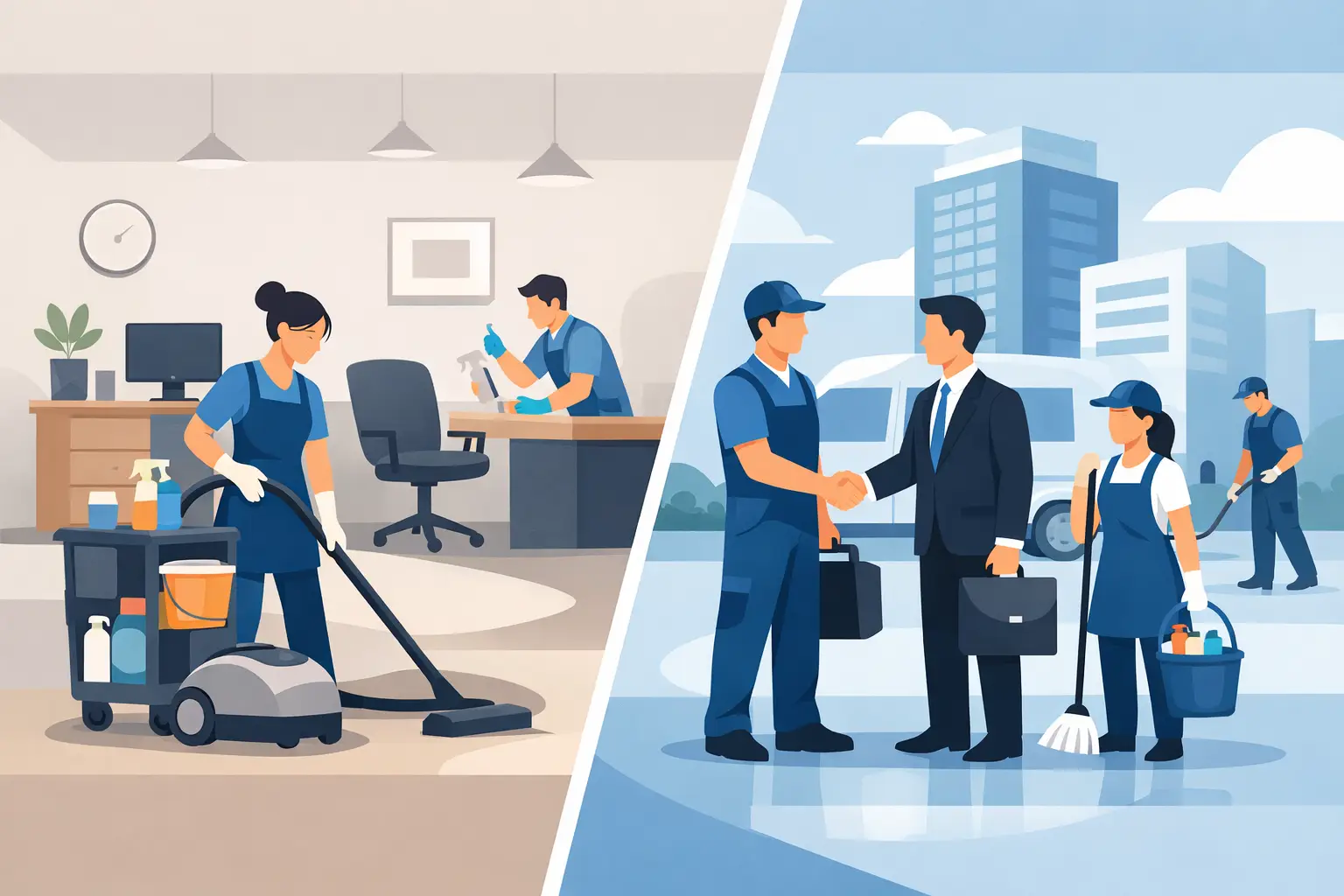
On paper, the difference looks simple. With in-house cleaning, your organization hires and manages its own custodial staff. With outsourcing, a commercial cleaning provider handles staffing, supervision, training, scheduling, and supply coordination based on an agreed scope of work.
In practice, the difference is much bigger. An in-house model turns cleaning into an internal department. That means recruiting, payroll, training, coverage for absences, inventory management, equipment upkeep, quality control, and performance management all stay with your team. Outsourcing shifts those responsibilities to a service partner while your organization focuses on oversight and results.
That distinction matters more in commercial settings than many decision-makers expect. Cleaning is not just a set of tasks. It is a system that has to run consistently, often after hours, across changing occupancy levels, seasonal demands, and facility-specific standards.
Where in-house cleaning makes sense
There are cases where building an internal cleaning team is a reasonable choice. If you operate a large campus, a single site with steady cleaning needs throughout the day, or a facility where staff must be fully integrated into internal operations, in-house staffing can offer direct control.
Some organizations prefer having custodians on payroll because they want immediate access to staff during business hours. Schools, large institutions, and certain industrial operations may benefit from dedicated on-site personnel who know the building well and can respond to issues in real time.
An in-house team can also work when leadership is prepared to actively manage the function. If you already have strong HR support, procurement processes, safety oversight, and a facilities structure that can supervise cleaning staff properly, the model can be effective.
The challenge is that many businesses like the idea of control but underestimate the management load behind it. Hiring the staff is only the beginning. Retaining them, covering call-outs, monitoring quality, and keeping standards consistent across shifts is where the real work starts.
Where outsourcing often has the advantage
For offices, medical clinics, retail stores, condominiums, daycares, restaurants, gyms, warehouses, and multi-tenant properties, outsourcing often provides more operational stability. That is especially true when cleaning needs happen after hours or require different protocols for different parts of the building.
A qualified commercial cleaning company brings an existing structure: trained staff, supervisors, replacement coverage, documented procedures, supplies, equipment, and quality checks. That means the service is not dependent on one or two internal employees showing up every day. It is supported by a wider operating system.
This is one reason outsourced cleaning is common in busy or regulated environments. If a clinic needs disinfecting protocols, a daycare needs high-touch sanitation, or a warehouse needs floor care and dust control, the provider should already know how to staff and execute that work without the client building the process from scratch.
For many organizations, outsourcing is less about saving money and more about reducing operational friction. It removes a function that is necessary but time-consuming to manage internally.
Cost is not just hourly wages
Cost is usually the first comparison point in any in house cleaning vs outsourcing discussion, but it is also where many comparisons go wrong. Internal labor may look less expensive at first glance if you only compare hourly rates. That is not a complete number.
In-house cleaning costs include wages, payroll taxes, benefits, paid time off, uniforms, hiring time, background checks, training, supervision, cleaning chemicals, consumables, equipment purchases, equipment repairs, and replacement labor when someone is absent or leaves. There is also the cost of internal management time, which is often ignored even though someone on your team is absorbing it.
Outsourcing usually appears as a single contract cost, which makes budgeting simpler. It may be higher than hourly pay on paper, but the rate includes the infrastructure behind the service. In many cases, that bundled structure is what creates value. You are not just paying for labor. You are paying for reliability, accountability, and coverage.
The more variable your needs are, the more outsourcing tends to make financial sense. If your building has seasonal fluctuations, changing occupancy, or periodic deep-cleaning requirements, a service partner can usually adjust faster than an internal team.
Control vs accountability
One of the most common reasons businesses keep cleaning in-house is the belief that internal staff means better control. That can be true, but only if the organization has clear cleaning standards, active supervision, and time to enforce them.
Without those systems, in-house control becomes informal. Tasks get completed differently depending on the employee, the shift, or the manager on duty. Standards drift. Quality issues become recurring conversations instead of fixed processes.
Outsourcing changes the type of control you have. You are no longer directing every individual task in real time, but you gain contractual accountability. Scope, frequency, deliverables, inspection standards, and communication procedures can all be defined upfront. A strong provider should also have supervision in place so quality does not depend on client follow-up.
For most facility leaders, that is a better use of time. Instead of managing mops, supply closets, and shift coverage, they manage outcomes.
Staffing risk is often the deciding factor
Cleaning is one of the most interruption-sensitive functions in a building. When coverage fails, the impact is immediate and visible. Trash builds up, restrooms decline, floors deteriorate, and complaints increase quickly.
That is why staffing risk deserves more attention than it usually gets. An in-house model puts absenteeism, turnover, and training gaps directly on your organization. If one custodian quits, your team has to recruit and stabilize service again. If someone calls out before an evening shift, the work may simply not get done.
An outsourced provider should be built to absorb that risk. The company is responsible for staffing continuity, replacements, and supervision. For businesses that cannot afford inconsistency, this is often the strongest argument for outsourcing.
Compliance, safety, and facility type matter
Not every building can be cleaned the same way. Medical spaces, schools, food service environments, fitness centers, and industrial facilities all require different procedures, products, and attention points. The higher the hygiene sensitivity, the less room there is for guesswork.
An in-house team can absolutely be trained to those standards, but the organization has to invest in that training and keep it current. That includes product handling, dilution, infection prevention practices, safe storage, and task-specific methods for different surfaces and spaces.
An experienced commercial provider should already operate with those standards in mind. That does not mean every vendor is equal. It means the evaluation should focus on training, insurance, supervision, consistency, and whether the cleaning program is tailored to the facility rather than offered as a generic package.
In the GTA market, that facility-specific approach is often what separates dependable service from recurring problems. A warehouse, clinic, and condominium lobby all need different cleaning plans, different schedules, and different quality checks.
So which model is better?
There is no universal answer. If you have a large site, strong internal management capacity, and a reason to keep cleaning fully integrated with your operations, in-house staffing can work well. If your priority is reducing management burden, improving consistency, and getting dependable coverage across changing needs, outsourcing usually has the edge.
For many organizations, the better question is not which model sounds better in theory. It is which model your team can realistically support without compromising building standards. Cleanliness affects how people experience your business every day. If the system behind it is unstable, the building will show it.
A practical decision starts with your actual environment: your hours, traffic, compliance requirements, staffing capacity, and tolerance for service disruption. Once those are clear, the right model usually becomes clear too. And if outsourcing is the better fit, a provider like Pristine Maintenance and Services should be judged on how well it can build around your facility, not how closely it resembles a one-size-fits-all cleaning crew.
The best cleaning arrangement is the one that keeps your space consistently clean, your standards protected, and your operations focused on the work only your team can do.
0 Comments