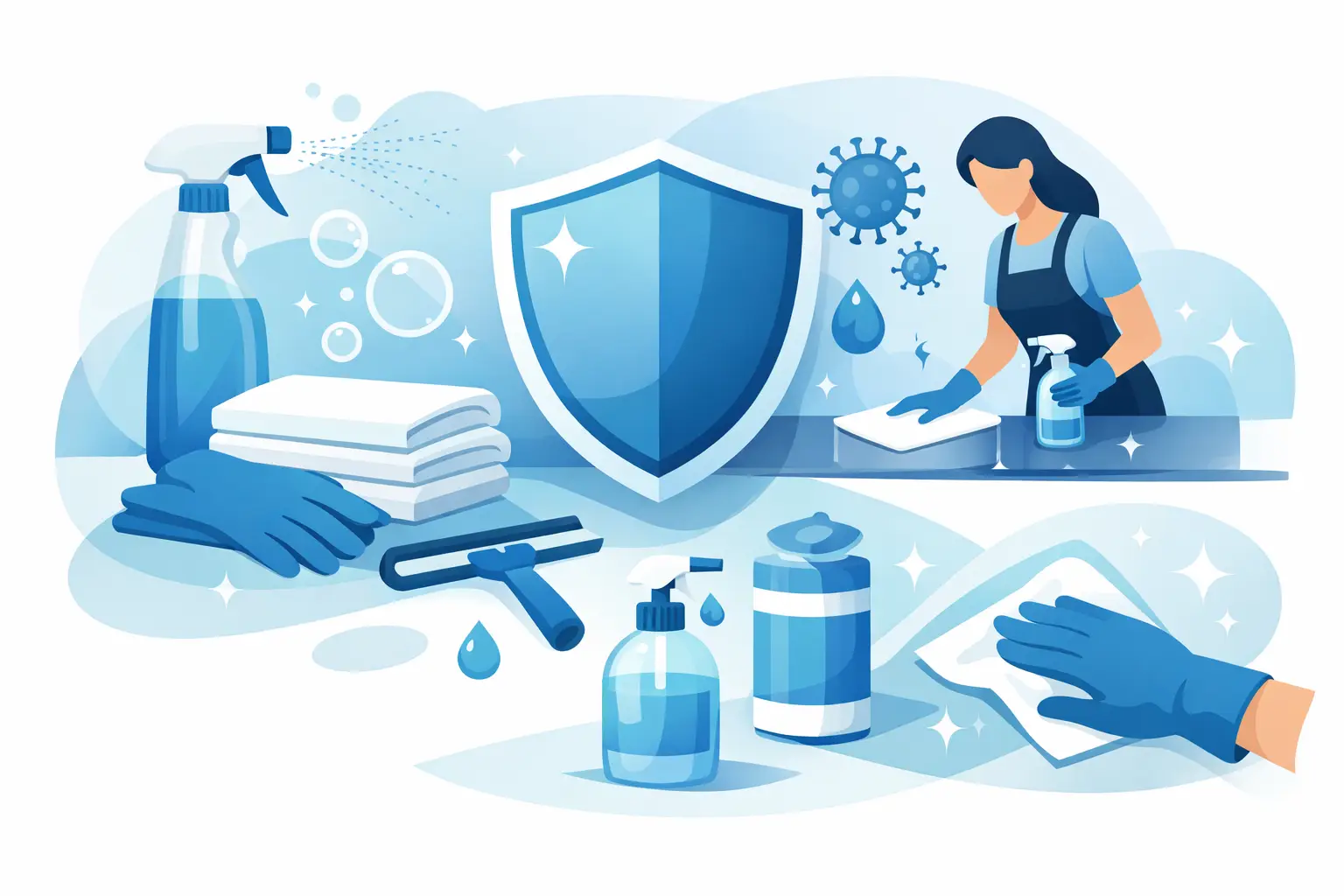

A desk can look spotless and still carry germs. A restroom can smell fresh and still fail hygiene expectations. For any business managing staff, visitors, tenants, or customers, knowing how to clean sanitize and disinfect is not a matter of appearance alone. It affects health, compliance, workplace confidence, and how your facility is judged every day.
In commercial environments, these three terms are often treated as if they mean the same thing. They do not. That misunderstanding leads to missed steps, wasted labor, and surfaces that appear clean without actually supporting a healthier space. The right process depends on the facility, the traffic level, and the type of contamination you are dealing with.
What clean, sanitize, and disinfect actually mean
Cleaning removes visible soil, dust, grease, spills, and debris from a surface. This is usually done with water, detergent, or general-purpose cleaning products. Cleaning lowers the amount of dirt and some germs, but it does not reliably kill bacteria or viruses.
Sanitizing reduces bacteria on a surface to a level considered acceptable under public health standards. This is especially relevant in food service areas, breakrooms, cafeterias, and shared touchpoints where lowering bacterial load is part of routine hygiene control.
Disinfecting uses an appropriate chemical product to kill a broader range of germs on hard, nonporous surfaces. This is often required in medical settings, restrooms, schools, daycares, fitness centers, and other high-touch or health-sensitive spaces. Disinfection is only effective when the product is used as directed, including proper dwell time.
That distinction matters operationally. If a surface is dirty, disinfectant may not work as intended. If a low-risk office area is disinfected constantly without a clear reason, you may be overspending on labor and chemicals where standard cleaning would be enough.
How to clean sanitize and disinfect in the right order
The order is straightforward: clean first, then sanitize or disinfect as needed. Skipping the first step is one of the most common mistakes in commercial cleaning programs.
Start by removing trash, dry debris, and surface dust. Then clean the area using the correct product for the material and the type of soil present. Grease in a kitchen, soap residue in a restroom, and dust in an office do not respond the same way to one generic cleaner.
Once the surface is visibly clean, decide whether sanitizing or disinfecting is the correct next step. In a breakroom table or food prep support area, sanitizing may be the appropriate standard. On restroom fixtures, door handles, shared equipment, and exam room touchpoints, disinfection is often the better fit.
After applying the product, let it remain wet for the required contact time listed on the label. This step is frequently rushed in busy facilities, but it is where the germ-killing action actually happens. Wiping a disinfectant off too soon can reduce its effectiveness significantly.
Choosing the right approach by facility type
Not every building needs the same level of treatment in every area. Effective cleaning programs are built around use patterns, not assumptions.
In office environments, routine cleaning and targeted disinfection of high-touch points usually make the most sense. Desks, keyboards, and personal items may also require occupant coordination, since not every item should be handled by janitorial staff without approval.
In medical clinics, disinfection standards are naturally higher. Exam rooms, waiting areas, counters, door hardware, and restrooms often require frequent touchpoint disinfection, along with stricter attention to product selection and cross-contamination control.
Schools and daycares bring a different challenge. Surfaces are touched constantly, and the cleaning program must balance effectiveness with safety. Product choice, drying time, and age-appropriate exposure concerns all matter.
Industrial sites and warehouses may need less frequent cosmetic detailing but more attention to dust control, shared equipment, break areas, washrooms, and floor safety. In these facilities, soil load can interfere with sanitation efforts if routine cleaning is not thorough.
Restaurants, gyms, and retail spaces operate under high traffic and public visibility. Here, surface hygiene and presentation are tied closely together. A facility that looks neglected will also be assumed to be unhygienic, whether that assumption is fair or not.
High-touch surfaces need special attention
If your team is deciding where to focus labor, high-touch surfaces are the first place to look. These are the points where cleaning for appearance is not enough.
Door handles, push plates, elevator buttons, handrails, light switches, faucet handles, flush levers, shared desks, reception counters, telephones, touchscreens, fitness equipment, and breakroom appliance handles all deserve regular review. In many facilities, these are touched hundreds of times a day.
Frequency should match traffic and risk. A low-traffic administrative office may only need scheduled touchpoint disinfection once or twice daily, while a clinic, daycare, or fitness facility may require much more frequent attention. There is no universal schedule that works across all property types.
Common mistakes that weaken results
The biggest mistake is treating all products as interchangeable. A glass cleaner is not a disinfectant. A deodorizer is not a sanitizer. Even within disinfectants, some products are designed for specific pathogens, surfaces, or settings.
Another problem is overapplying chemical products without a plan. More product does not always mean better hygiene. It can leave residue, create slip hazards, damage materials, or irritate occupants.
Poor cloth and mop management is another issue. If staff use the same tools across restrooms, kitchens, and general workspaces, cross-contamination becomes a real concern. Color coding, laundering protocols, and clear area separation are basic controls that matter.
Training also makes a major difference. A product is only as effective as the method behind it. If staff are not following dilution instructions, contact times, or surface compatibility guidance, results become inconsistent.
Product safety and surface compatibility
Commercial facilities include many surface types, and not all of them respond well to aggressive chemicals. Stainless steel, laminate, sealed stone, rubber flooring, electronic touchscreens, and upholstered surfaces each have different care requirements.
Using the wrong product can cause dulling, corrosion, discoloration, or premature wear. This is especially relevant in lobbies, tenant common areas, gyms, and medical environments where surfaces are both functional and public-facing.
Indoor air quality also matters. Stronger chemistry is not automatically the right choice, especially in occupied spaces. Ventilation, scent sensitivity, and occupancy patterns should be part of the decision. In some facilities, after-hours service is the safest and most practical way to complete more intensive disinfecting work without disrupting operations.
Building a workable routine
A reliable program separates daily tasks from periodic ones. Daily work usually covers visible cleanliness, restocking, trash removal, and high-touch surface treatment. Periodic work addresses deeper floor care, detailed dusting, wall spots, vent cleaning, and less-accessible surfaces that still affect hygiene over time.
Documentation helps. Facility managers should know what is being cleaned, how often, with which products, and at what standard. This is particularly useful in regulated settings, shared commercial properties, and buildings where multiple stakeholders expect accountability.
For many organizations, the most practical answer is not to ask whether every surface should be disinfected all the time. The better question is where disinfecting adds value, where sanitizing is appropriate, and where routine cleaning is enough. That is how labor stays efficient without lowering standards.
When outside support makes sense
Some businesses can manage basic in-house cleaning, but many commercial properties outgrow that model quickly. Once you add multiple shifts, shared spaces, public traffic, compliance demands, or specialized facility requirements, consistency becomes harder to maintain internally.
That is where a facility-specific plan matters. A professional provider should assess traffic patterns, touchpoint risk, surface types, and operational constraints before setting frequencies and methods. Pristine Maintenance and Services approaches commercial cleaning this way because offices, clinics, schools, industrial sites, and residential common areas do not operate under the same conditions.
A customized scope is usually more effective than a generic package. It reduces wasted effort, improves hygiene outcomes, and helps ensure cleaning activity supports the way the building actually functions.
Clean spaces build trust, but trust is usually earned in the details. When your process is clear, your products are appropriate, and your team knows when to clean, sanitize, and disinfect, the facility performs better for everyone who walks through it.

0 Comments