
When a facility manager says a space needs to be sanitized, and another team member asks for disinfection, they may sound like they are asking for the same thing. In practice, the difference between disinfection and sanitization affects product selection, cleaning procedures, staff training, compliance expectations, and the level of risk a facility is trying to control.
For businesses, schools, clinics, warehouses, restaurants, and shared commercial properties, this is not just a wording issue. Choosing the wrong approach can lead to unnecessary costs in some environments and insufficient hygiene control in others. The right standard depends on who uses the space, how often surfaces are touched, and what kind of exposure your operation needs to reduce.
What is the difference between disinfection and sanitization?
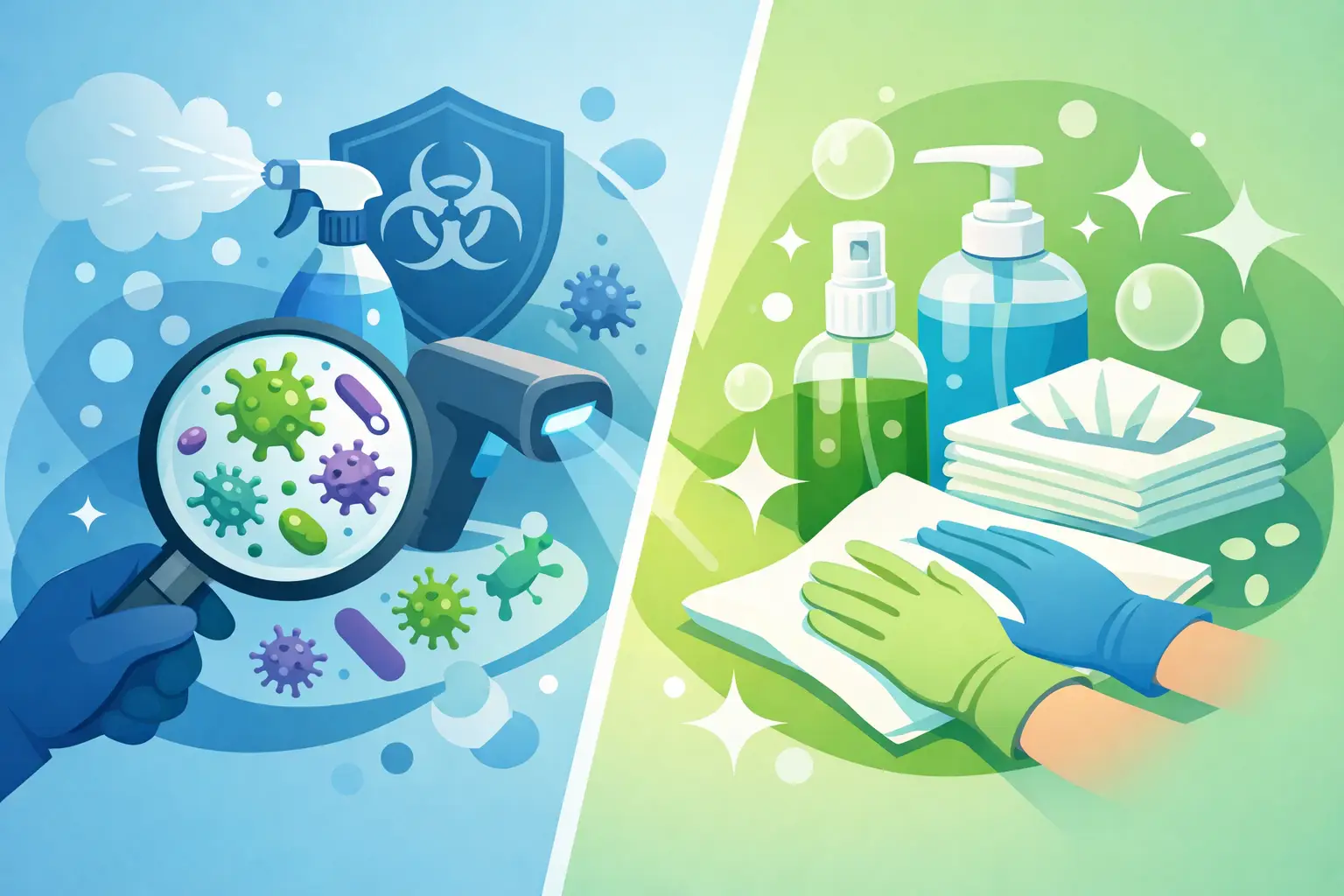
Sanitization reduces the number of germs on a surface to a level considered acceptable under public health standards. It lowers contamination and supports routine hygiene, especially in spaces where surfaces are touched often but do not always require the highest level of microbial control.
Disinfection goes further. It uses chemical agents approved for that purpose to kill or inactivate a broader range of harmful microorganisms on hard surfaces. In most commercial settings, disinfection is used when there is a higher risk of illness transmission, greater public exposure, or stricter hygiene requirements.
The simplest way to think about it is this: sanitization reduces, while disinfection is intended to kill specific germs on treated surfaces when used correctly.
That distinction matters because many decision-makers use the two terms interchangeably when writing scopes of work, reviewing vendor proposals, or responding to health concerns in the building. A cleaning plan becomes much more effective when those terms are defined clearly from the start.
Why the difference between disinfection and sanitization matters in commercial facilities
In a commercial environment, cleaning standards should match operational reality. An accounting office with controlled access and standard foot traffic does not usually need the same routine treatment as a medical clinic, daycare, fitness center, or restaurant washroom.
If a contractor disinfects every surface in every room every night, the result may be more expensive than necessary, and in some cases harder on surfaces and finishes over time. On the other hand, if a space with frequent touchpoints, shared equipment, or elevated exposure risk is only sanitized when disinfection is more appropriate, the cleaning program may fall short of what the environment demands.
This is why facility-specific planning matters. Commercial cleaning is not strongest when it uses the most aggressive method everywhere. It works best when the level of service matches the use of the space, the traffic pattern, and the hygiene standard expected by the client, staff, tenants, or visitors.
Sanitization in day-to-day operations
Sanitization is often the right fit for routine maintenance in lower-risk commercial spaces. It helps control microbial levels on surfaces such as desks, counters, breakroom tables, door hardware, shared touchpoints, and some food-contact areas, depending on the product used and the setting.
For many offices, retail locations, condominium common areas, and administrative areas, sanitization can support a clean and healthy environment without applying a disinfection-level process across every surface. It is practical, efficient, and often appropriate for recurring service when paired with proper cleaning techniques.
That said, sanitization still requires correct execution. A surface usually needs to be cleaned of visible soil first. The product must be suitable for the surface, and staff need to follow label directions, including contact time. If those steps are skipped, the result may not meet the intended standard even if the right product was selected.
Where disinfection is typically the better choice
Disinfection is more appropriate in environments where infection control is a bigger concern or where vulnerable populations are present. Medical clinics, treatment rooms, schools, daycares, gym equipment zones, washrooms, food service back-of-house areas, and high-touch common surfaces during illness outbreaks are common examples.
In these settings, the goal is not just to reduce general contamination. It is to actively address pathogens that may spread through shared surface contact. That usually means using disinfectants registered for that purpose, applying them to cleaned hard surfaces, and allowing enough dwell time for the product to work as intended.
There is also an operational reason many businesses request disinfection. It can support internal protocols, tenant expectations, and reputational standards. If employees, customers, or residents expect a visibly managed hygiene program, especially after a known illness event, disinfection may be the more appropriate response.
Cleaning comes first, no matter which one you choose
One of the most common misunderstandings is that sanitization or disinfection replaces cleaning. It does not. Soil, grease, dust, and residue can interfere with how well a sanitizer or disinfectant performs.
If a lunchroom table has food residue on it, or a washroom counter has soap film and grime buildup, applying a disinfectant on top does not guarantee effective results. In most commercial protocols, the surface should first be cleaned, then sanitized or disinfected based on the required outcome.
This matters for procurement and service planning. When vendors describe their process, businesses should look beyond simple promises like sanitized facility or disinfected workspace. The better question is how the surfaces are prepared, what products are used, and where each level of treatment is built into the schedule.
It depends on the facility type
A strong cleaning program is based on risk level, not broad assumptions. In an office, daily sanitization of touchpoints and periodic disinfection of washrooms and shared kitchens may be enough. In a daycare, disinfection of high-contact surfaces and shared items may need to happen much more frequently. In a warehouse, the focus may be on washrooms, time clocks, break areas, and shared equipment rather than every square foot of floor space.
Medical and health-adjacent environments usually require a more structured disinfection program. Restaurants and food-prep areas may require sanitization for certain surfaces and disinfection for others depending on use, regulations, and product suitability. Fitness facilities often need close attention to equipment, locker rooms, and frequently touched common areas.
This is where a customized service plan adds value. A blanket specification can miss the real problem areas in a building, while also overservicing lower-risk areas that do not need the same level of treatment.
How to choose the right standard for your building
Business owners and facility managers do not need to become chemists to make a sound decision, but they do need clarity on what they are asking for. Start with the use of the space. Ask who touches the surface, how often, whether food, bodily fluids, or health-sensitive activity is involved, and whether there are regulatory or internal policy requirements.
Then consider the practical side. How often can the area be serviced? Does the product need a certain dwell time that affects turnover? Are there materials in the building that require special care? Will a stronger protocol create odor, residue, or wear concerns in client-facing spaces?
In many facilities, the answer is not sanitization or disinfection across the board. It is a combination. Some spaces need routine sanitization for daily maintenance, while others need scheduled or event-based disinfection. That approach is often more cost-effective and more aligned with actual risk.
For this reason, experienced commercial providers build scopes around zones, frequencies, and touchpoint priorities rather than using one cleaning claim for the entire property. Pristine Maintenance and Services, for example, works with businesses that need cleaning programs matched to how their facilities actually operate, not generic checklists.
Questions worth asking your cleaning provider
If you are reviewing a janitorial proposal, ask what the team means by sanitized versus disinfected. Ask which surfaces receive each treatment, how often they are serviced, what products are being used, and whether staff are trained on proper contact times and safe application.
You should also ask how the program changes when conditions change. A flu outbreak, a tenant complaint, a seasonal traffic spike, or a confirmed contamination event may require temporary upgrades in disinfection frequency. A dependable commercial provider should be able to adjust without disrupting your operation.
The best cleaning plans are clear, documented, and realistic. They reflect the building type, traffic level, and hygiene expectations of the people responsible for the space.
Understanding the difference between disinfection and sanitization helps you ask for the right service instead of the loudest promise. When the cleaning standard fits the actual environment, your facility is easier to maintain, easier to trust, and better prepared for the day-to-day demands of business.

0 Comments