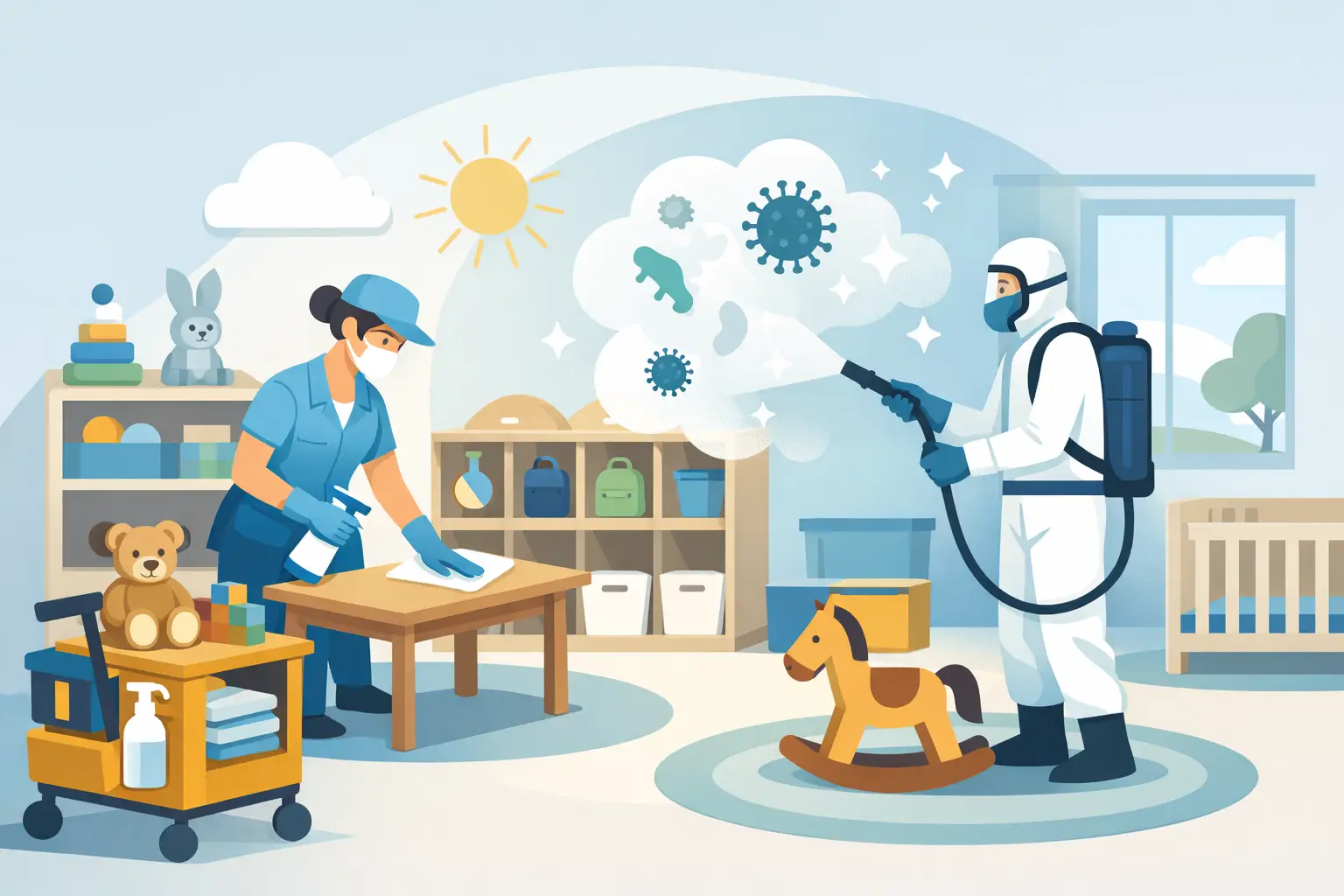

A daycare can look tidy at pickup and still carry the kind of contamination that spreads fast the next morning. Shared toys, nap mats, sink areas, diaper stations, door hardware, and child-height touchpoints create a cleaning environment that moves differently than an office or retail space. That is why daycare sanitizing services need to be built around how children use the space, not around a generic nightly cleaning checklist.
For daycare operators, directors, and facility managers, sanitation is not a cosmetic issue. It affects parent confidence, staff workload, illness-related absences, and the daily pace of the classroom. The right service program supports a healthier environment while fitting around strict schedules, licensing expectations, and the practical reality that the building is in constant use.
What daycare sanitizing services should actually cover
In a daycare setting, high-touch surfaces are everywhere, and many of them are lower to the ground or shared more frequently than in other facilities. Sanitizing needs to address classroom tables, toy storage bins, cots, changing stations, restroom fixtures, faucets, push plates, cubbies, and common entry points. It also needs to account for surfaces that are touched by both children and staff throughout the day.
That sounds straightforward, but the challenge is in the details. Some materials need frequent sanitizing but careful product selection. Others require a separate cleaning step before disinfecting can be effective. Soft surfaces, sensory play items, and rotating toy inventory may also require a different process than hard floor areas or washrooms.
A dependable provider does not treat the whole building as one cleaning zone. Daycare classrooms, food prep areas, staff rooms, reception, sleeping spaces, and washrooms all have different use patterns and sanitation priorities. When the cleaning plan reflects those differences, results are more consistent and easier to maintain.
Why generic cleaning programs fall short in daycare environments
Many commercial cleaners can mop floors and empty trash. That is not the same as understanding a childcare environment. A daycare has a higher frequency of hand contact, more shared surfaces, more bodily fluid risk, and a lower margin for missed details.
A one-size-fits-all program often focuses heavily on visible tasks and not enough on infection-control touchpoints. That can leave gaps in areas such as toy sanitizing schedules, restroom disinfection, change table procedures, and repeated treatment of common-contact surfaces. It can also create operational issues if crews arrive at the wrong time, use products with strong lingering odors, or disrupt classroom setup for the next day.
This is where customized daycare sanitizing services matter. The schedule, scope, products, and frequency should match the actual operating rhythm of the facility. A center with infant rooms and extended hours will not have the same needs as a preschool program with part-time attendance. A provider that builds around the building will usually perform better than one that tries to fit the building into a standard package.
The operational value of a customized sanitizing plan
For decision-makers, the benefit of professional sanitizing is not limited to cleanliness. It is also about control. When there is a clear service plan, staff are not left guessing what the cleaning company handles versus what classroom teams need to address during the day.
That division of responsibility matters. If after-hours crews are consistently sanitizing toys, surfaces, washrooms, floors, and common areas according to scope, internal staff can stay focused on supervision and programming instead of making up for missed cleaning tasks. It also makes quality checks more straightforward because expectations are defined in advance.
A strong plan usually includes room-by-room task mapping, attention to high-touch frequencies, safe product use, and service timing that avoids interrupting children, educators, or parents. In many cases, after-hours service is the most practical option because it allows more thorough work without competing with active classroom use.
There is a trade-off, though. More frequent sanitizing and more detailed scope typically mean more labor and higher service cost. For many facilities, the right answer is not maximum intensity everywhere. It is targeted intensity in the areas that carry the highest sanitation risk.
Daycare sanitizing services and compliance expectations
Daycare operators are used to being evaluated on environment, safety, and cleanliness. While exact requirements vary by jurisdiction and facility type, the standard is clear: the site must be maintained in a way that protects children and supports healthy operation.
Professional sanitizing helps support that standard when it is documented, consistent, and aligned with the facility’s procedures. That includes using appropriate products, following safe dwell times, and applying methods that are suitable for childcare settings. It also means avoiding shortcuts, such as spraying and wiping immediately when the product requires longer surface contact to work properly.
Buyers should also think about training and insurance. Daycare environments require more than basic janitorial labor. Staff should understand cross-contamination prevention, washroom sanitation, change-area protocols, and how to work carefully around classroom materials and child-focused furnishings. A trained, insured service provider reduces operational risk while giving management a clearer standard of accountability.
What to look for when hiring a daycare sanitizing provider
The right vendor should be able to explain how they would clean a daycare differently from an office, clinic, or warehouse. If the answer sounds generic, that is usually a warning sign. Daycare work requires a facility-specific approach, and the provider should be comfortable discussing room types, touchpoints, frequency, and how they handle product safety.
Scheduling flexibility is another major factor. Daycares often need service after pickup, before opening, or during very narrow windows. A provider that cannot work around the program schedule may create more disruption than value. Reliability matters just as much. Missed cleanings or inconsistent performance can quickly affect staff confidence and parent perception.
It is also worth asking how quality is managed. Who inspects the work? How are issues reported and corrected? What happens if there is an illness outbreak, a bodily fluid incident, or a need for added disinfection support on short notice? In a childcare environment, responsiveness is part of the service, not an extra.
Areas that deserve extra attention in daycare sanitizing services
Some parts of a daycare need repeated focus because they combine heavy use with a higher chance of contamination. Washrooms and diapering areas are obvious examples, but they are not the only ones. Entry doors, sign-in stations, drinking fountain buttons, play tables, chair backs, sleeping mats, and toy rotation bins all deserve structured attention.
Food-related zones also need a disciplined approach. Sanitizing in eating areas has to support hygiene without creating chemical concerns around surfaces children use closely. That usually means proper product selection, careful application, and staff who understand the difference between cleaning for appearance and cleaning for health protection.
Floors matter too, especially in infant and toddler rooms where children spend more time close to the surface. In those areas, floor cleaning is not just a background task. It is part of the broader sanitation strategy.
Choosing a program that matches your facility
The best daycare sanitizing services are not necessarily the most extensive on paper. They are the ones that fit the building, the age groups served, the occupancy level, and the operating schedule. A smaller center may need a focused recurring plan with periodic deep sanitizing. A larger multi-room facility may need a more segmented program with different frequencies by zone.
That is why walkthroughs and scope discussions matter. Before service starts, the provider should understand where children eat, sleep, play, wash hands, and transition between rooms. They should know which surfaces are used most, which areas are hardest for staff to maintain during operating hours, and where sanitation failures would create the biggest operational problem.
For facilities in busy markets, dependable execution becomes even more important. Companies such as Pristine Maintenance and Services focus on customized commercial cleaning programs because regulated and high-traffic spaces rarely perform well under generic janitorial models. In daycare settings, that tailored approach tends to produce better consistency and fewer gaps.
Professional sanitizing is not there to replace the good habits of staff or the daily routines of a well-run center. It is there to strengthen them. When the service plan is built around the real demands of childcare operations, the result is a cleaner environment, a more manageable workload for your team, and a facility that feels ready for the next day before the first child walks through the door.

0 Comments