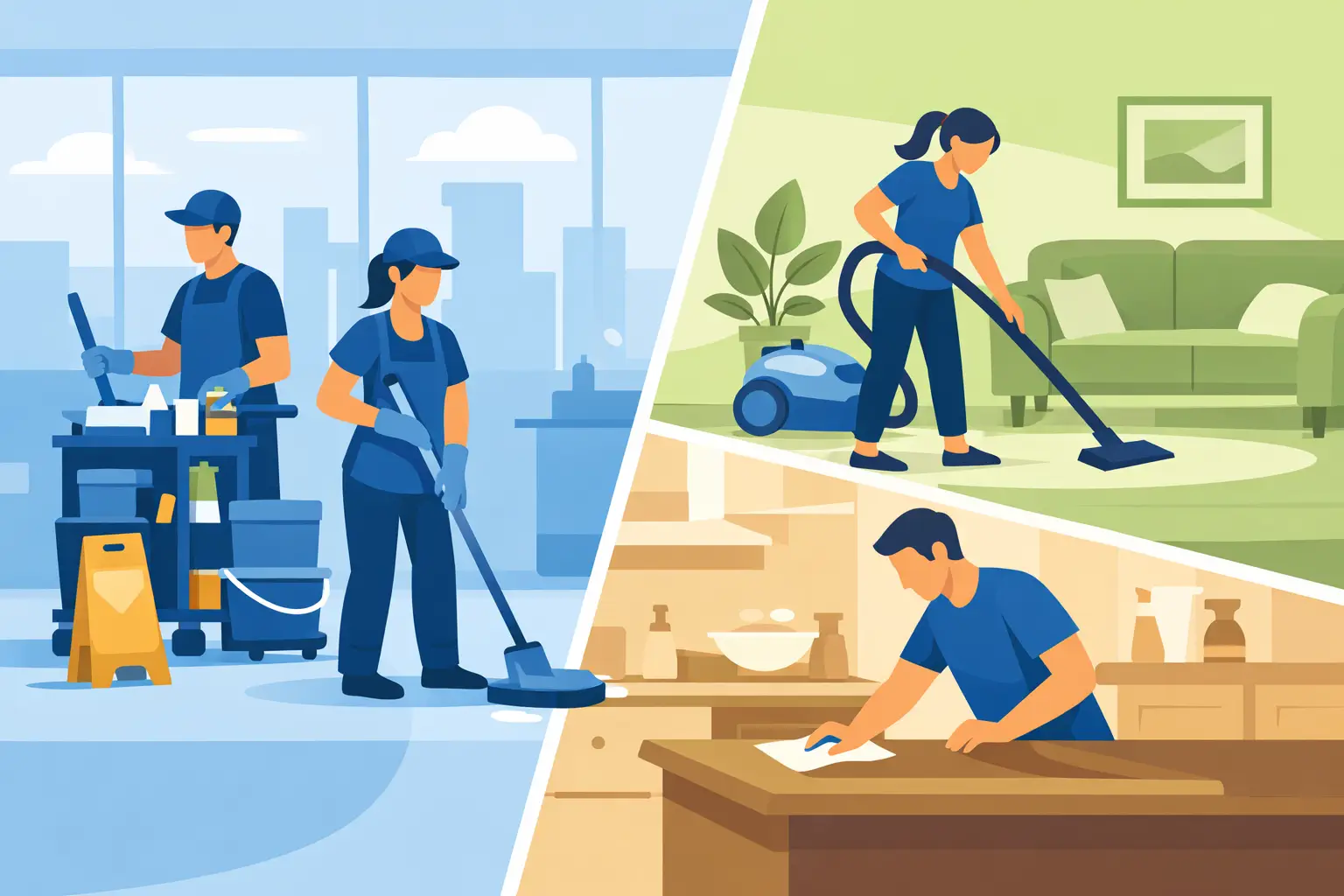

When a facility starts missing cleaning standards, the problem usually shows up fast – restrooms run low, floors lose their finish, garbage sits too long, and staff notice before management does. That is why the question of janitorial services vs in house cleaning is not just about who empties bins or mops floors. It is an operational decision that affects labor, accountability, safety, appearance, and the daily experience inside your building.
For some organizations, keeping cleaning in house makes sense. For others, outsourcing delivers better consistency and less administrative strain. The right answer depends on your building type, staffing capacity, compliance needs, hours of operation, and tolerance for management overhead.
Janitorial services vs in house: what is the real difference?
At a basic level, in-house cleaning means your organization hires and manages its own cleaning staff. You handle recruiting, payroll, scheduling, supervision, training, supplies, equipment, and coverage when someone calls out. The cleaners are your employees, and the cleaning operation becomes one more internal department to run.
Janitorial services mean a third-party provider takes responsibility for delivering cleaning according to an agreed scope and schedule. The provider supplies labor management, training, supervision, and often the systems needed to maintain quality across recurring service. In many commercial environments, this arrangement gives operations teams a clearer line of accountability because the expected tasks, frequencies, and standards are defined upfront.
That distinction matters more in commercial settings than many buyers expect. An office with 20 employees has different demands than a medical clinic, school, warehouse, gym, or condominium common area. Cleaning is not one uniform task. It is a facility support function that has to match traffic levels, hygiene risks, and operating hours.
Cost is not just hourly wages
A common reason businesses consider in-house cleaning is the belief that it will cost less. On paper, an hourly wage may look lower than a service contract. In practice, the true cost is broader.
With in-house staffing, wages are only the starting point. You also absorb payroll taxes, benefits, workers’ compensation, recruitment time, background checks, onboarding, training, supervision, uniforms, equipment purchases, repair and replacement, consumables, and paid time off. If your cleaner is absent, someone still has to arrange coverage. If no coverage is available, standards slip immediately.
Outsourced janitorial services usually package these variables into one service structure. That can make budgeting more predictable, especially for facilities that need recurring cleaning several days a week or after hours. It also reduces the hidden labor spent by office managers, property teams, or operations staff who otherwise become part-time cleaning coordinators.
This does not mean outsourcing is always cheaper. A very small site with light cleaning needs may decide that a limited in-house arrangement is workable. But for multi-shift buildings, regulated environments, or facilities with broad cleaning demands, outsourcing often lowers the administrative cost of getting dependable results.
Control sounds good until it becomes supervision
The strongest argument for in-house cleaning is control. Your team sets priorities directly, communicates with employees face to face, and can adjust tasks in real time. Some organizations value that immediate access, especially if they already have a strong facilities department and stable staffing.
The trade-off is that control requires management capacity. Someone has to inspect work, train new hires, restock supplies, manage time-off requests, respond to complaints, enforce safety procedures, and address performance issues. In-house control is only useful if your organization has the time and structure to exercise it well.
With a janitorial provider, you give up some direct day-to-day control over personnel, but in return you gain a service system. A professional vendor should offer site-specific scopes, scheduled service delivery, supervisory oversight, and a clear process for issue resolution. For many property managers and business owners, that is a better form of control because expectations are formalized instead of improvised.
Staffing risk is one of the biggest deciding factors
Cleaning is labor-dependent, and labor consistency is where many in-house models struggle. Turnover, absenteeism, vacation coverage, and uneven training can quickly affect the condition of a building. This is especially true in facilities that cannot afford service gaps, such as schools, medical offices, high-traffic retail environments, or shared common areas.
When cleaning is outsourced, staffing continuity becomes the provider’s responsibility. If one cleaner is unavailable, the service company is expected to provide coverage and maintain standards. That does not remove all risk, but it shifts the burden away from your internal team.
For organizations with lean administrative staff, that shift matters. The less time your office administrator, property manager, or operations lead spends solving cleaning labor issues, the more time they can spend on their actual role.
Quality depends on systems, not good intentions
An in-house cleaner who is reliable and experienced can do excellent work. The challenge is consistency over time, across tasks, and under changing conditions. Quality is not only about effort. It depends on training, documented procedures, proper product use, equipment maintenance, and regular inspection.
That is where janitorial services often have an advantage, particularly in commercial environments with specialized needs. A qualified provider should understand floor care, restroom sanitation, touchpoint disinfection, waste handling, and safe cleaning practices for different surfaces and occupancies. In facilities such as clinics, daycares, restaurants, gyms, and industrial spaces, that experience becomes more valuable because poor cleaning can create operational and reputational problems.
If your building has compliance expectations or heightened sanitation standards, in-house cleaning can still work, but only if you invest in the right protocols and oversight. Without that structure, quality tends to become person-dependent rather than system-dependent.
Janitorial services vs in house for different facility types
Building type changes the equation. In a straightforward office with predictable traffic, either model may work if expectations are modest and management is disciplined. In a small owner-occupied location, in-house cleaning may feel manageable.
As soon as the environment becomes more complex, outsourced janitorial support tends to make more sense. Medical spaces need stronger sanitation control. Schools and daycares need dependable cleaning in high-contact environments. Warehouses and industrial buildings often require attention to dust, debris, breakrooms, restrooms, and shift schedules. Condominiums and managed properties need common areas maintained consistently without disrupting residents. Restaurants and gyms need frequent cleaning in spaces where appearance and hygiene are highly visible.
In these settings, a customized service plan matters more than a generic cleaning checklist. That is one reason many organizations choose providers such as Pristine Maintenance and Services – the cleaning program can be built around the facility rather than forced into a standard package.
Flexibility and after-hours service can decide the issue
One of the less obvious benefits of outsourced janitorial service is scheduling flexibility. Many commercial spaces need cleaning completed before opening, after closing, or around tenant and staff activity. Coordinating that internally can be difficult, especially when you rely on one or two employees.
A service provider is usually better positioned to support after-hours cleaning, scalable frequency, and adjustments during seasonal changes, outbreaks, tenant turnover, or special events. That flexibility is valuable when the building cannot pause operations for maintenance work.
In-house teams can provide flexibility too, but only if staffing levels are deep enough to support it. In many organizations, they are not.
So which option is better?
If your facility is small, your cleaning needs are simple, and you already have the management structure to hire, train, supervise, and backfill staff, in-house cleaning may be a reasonable choice. It can work well where direct oversight is easy and expectations are limited.
If your building has variable traffic, specialized sanitation needs, multiple areas to maintain, or little room for missed service, janitorial services are often the stronger option. They reduce administrative burden, improve coverage, and create a clearer accountability structure for recurring cleaning performance.
The better question is not which model is universally best. It is which model gives your facility the most reliable outcome with the least operational friction. A cleaning program should support your business, not become another problem your team has to manage.
If you are weighing janitorial services vs in house, start by looking at where your current process breaks down. If the issue is not effort but consistency, coverage, supervision, or facility-specific standards, that is usually a sign you need a more structured service model. The cleanest buildings are rarely the ones with the cheapest plan. They are the ones with the clearest responsibility and the fewest opportunities for standards to slip.
0 Comments