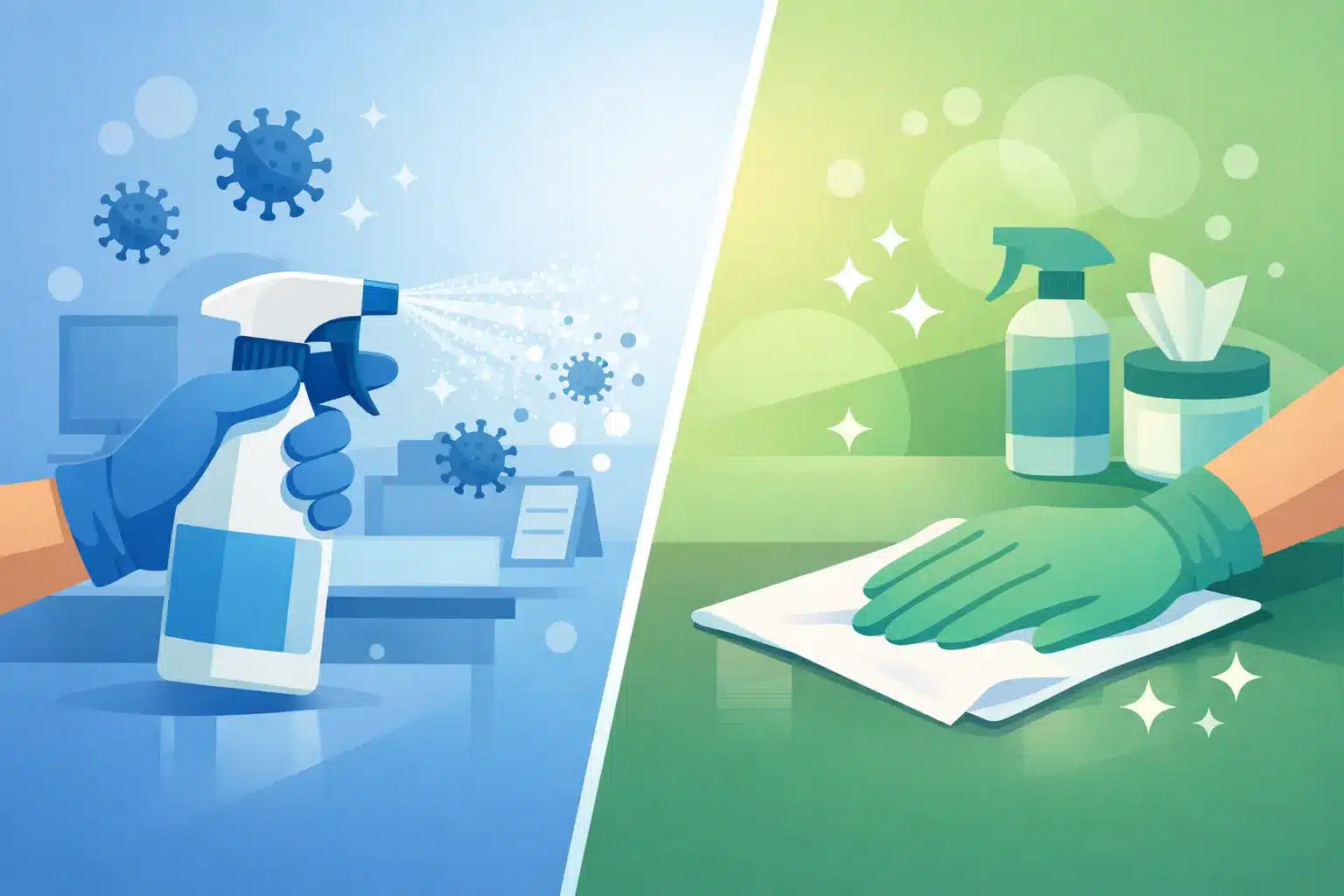

A restroom touchpoint, a shared conference table, and an exam-room counter do not carry the same risk. That is why disinfecting vs sanitizing workplace surfaces should be an operational decision, not a catch-all cleaning term. Choosing the wrong approach can leave high-risk areas under-treated, while overusing stronger products can add cost, disrupt operations, and damage certain finishes.
For facility managers, property managers, and business owners, the goal is straightforward: use the right level of surface hygiene for the space, the traffic, and the people using it. A practical program accounts for how a facility operates throughout the day, not simply how it looks after a cleaning shift.
What Sanitizing Means in a Commercial Facility
Sanitizing reduces the number of bacteria on a surface to a level considered safe by public health standards. It is commonly used in workplaces where routine cleanliness and food-safe practices matter, but where there is no known elevated illness risk requiring a higher-level treatment.
In an office, sanitizing may be appropriate for shared desks, break-room tables, cabinet handles, and other frequently touched surfaces as part of regular janitorial service. In restaurants and food-service settings, sanitizing is a core requirement for food-contact surfaces after they have been washed and rinsed. The product and dilution must be suitable for that purpose, and staff must follow the label directions.
Sanitizing supports a clean, well-maintained environment, but it is not the same as disinfection. It may not address the full range of pathogens a disinfectant is designed to kill. This distinction matters most in facilities with vulnerable populations, heavy public traffic, or a known illness concern.
What Disinfecting Means
Disinfecting uses an appropriate registered disinfectant to kill or inactivate specified germs on hard, nonporous surfaces. Product labels identify the organisms a product is effective against, the required dilution if applicable, and the contact time needed for the product to work.
Contact time is often missed in rushed cleaning routines. A surface must remain visibly wet for the full label-specified period. Spraying a disinfectant and wiping it away immediately may clean the surface, but it may not deliver the disinfection result the facility expects.
Disinfection is generally appropriate for restroom fixtures and touchpoints, clinic treatment areas, gym equipment, high-touch elevator buttons, shared devices, and other areas where exposure risk is higher. It can also be increased temporarily after an illness event, during seasonal outbreaks, or when a facility’s internal health protocol calls for it.
Disinfecting vs Sanitizing Workplace Surfaces: The Practical Difference
The simplest distinction is that sanitizing reduces germs, while disinfecting targets a broader range of disease-causing microorganisms based on the product’s approved claims. Neither step replaces cleaning. Dirt, food residue, oils, and other soil can interfere with a sanitizer or disinfectant reaching the surface effectively.
A reliable process usually follows this order: remove visible soil, apply the appropriate sanitizing or disinfecting product, maintain the required wet contact time, then allow the surface to air dry or wipe it as the label permits. Skipping the cleaning step is one of the most common reasons a surface hygiene program falls short.
The stronger option is not automatically the better option. Repeated disinfection may be unnecessary for low-risk surfaces, and certain chemicals can affect flooring, electronics, upholstery, stone, wood finishes, or equipment when used incorrectly. A facility-specific plan should balance germ control with material compatibility, occupant comfort, and the pace of daily operations.
How to Decide What Your Facility Needs
Start with risk rather than product preference. Consider who uses the space, how often surfaces are touched, whether food is handled, and whether the environment serves people with greater health sensitivities.
An administrative office with assigned workstations may need regular cleaning and targeted sanitizing of common areas, with disinfection focused on restrooms and high-touch points. A medical clinic will typically require more frequent and more carefully documented disinfection in patient-facing and treatment areas. A daycare, school, gym, warehouse lunchroom, or condominium common area may need a different schedule again because of traffic patterns, shared equipment, and the type of contact occurring in each space.
Facilities should also adjust service when conditions change. A spike in employee absences, a reported gastrointestinal illness, a respiratory illness concern, or a large event can justify increased attention to touchpoints and a temporary disinfection protocol. That response should be targeted and communicated clearly, rather than treated as a permanent blanket measure.
Focus on High-Touch Surfaces First
Some surfaces create more opportunity for transfer than others. Door handles, light switches, faucet handles, toilet flush levers, elevator controls, shared keyboards, reception counters, payment terminals, and break-room appliances deserve regular attention because many people touch them throughout the day.
The right frequency depends on traffic. A quiet professional office may be adequately served with after-hours treatment and daytime spot service. A busy retail location, clinic, school, or fitness center may require repeated attention during operating hours. Cleaning frequency should follow the actual use of the space, not a generic checklist.
Match Products to the Surface and Task
Every chemical program should be guided by the manufacturer’s label and safety documentation. This is especially important for food-contact areas, medical environments, electronics, and surfaces that can be damaged by moisture or certain active ingredients.
Staff need to know which product is assigned to which task, how to prepare it, what personal protective equipment is required, and how long it must remain wet. Mixing chemicals or using a disinfectant at the wrong concentration can create safety risks and compromise results. Proper storage, labeled bottles, and consistent training are basic controls that protect both occupants and cleaning personnel.
Build the Process Into Daily Operations
Surface hygiene works best when it is built into the service plan instead of handled only after a complaint or outbreak. A professional cleaning program can identify touchpoint zones, define cleaning frequencies, assign appropriate products, and schedule work when it causes the least disruption.
After-hours service is often useful for offices, retail spaces, schools, and shared residential properties because cleaning teams can complete detailed work without working around customers, tenants, or staff. However, some settings also benefit from daytime porter support. A porter can address washroom conditions, spills, touchpoints, and consumable supplies while the building is occupied.
Documentation can be valuable in regulated or health-sensitive environments. A simple record of completed tasks, products used, and issue reporting provides greater accountability than an informal routine. For a medical office, daycare, food-service area, or multi-tenant building, that visibility helps managers confirm that the planned standard is being delivered consistently.
Common Mistakes That Reduce Results
The first mistake is treating cleaning, sanitizing, and disinfecting as interchangeable terms. They are related, but they serve different purposes. The second is applying a product to a dirty surface and assuming the chemical will compensate for poor cleaning.
Another frequent issue is using a product without allowing its full contact time. Facilities also run into problems when every area receives the same treatment, regardless of traffic or risk. That approach can waste labor in low-priority areas while failing to give restrooms, shared equipment, and entry touchpoints the attention they need.
Finally, appearance alone is not a reliable measure of hygiene. A polished lobby can still have neglected high-touch surfaces, and an overly scented space is not proof that appropriate cleaning chemistry was used. Quality control should look at completed tasks, correct procedures, and the condition of critical touchpoints.
A Better Standard for Facility Hygiene
The best program is specific enough to fit the building and flexible enough to respond when conditions change. Pristine Maintenance and Services develops cleaning and disinfection plans around each facility’s layout, traffic, operating hours, and hygiene requirements, helping Toronto and GTA organizations maintain clean spaces without interrupting daily work.
A useful next step is to walk your facility as an occupant would. Notice every surface people share, every area where food or personal care occurs, and every point where traffic builds up. Those observations provide the clearest starting point for a surface hygiene plan that protects people while respecting the way your operation actually runs.

0 Comments