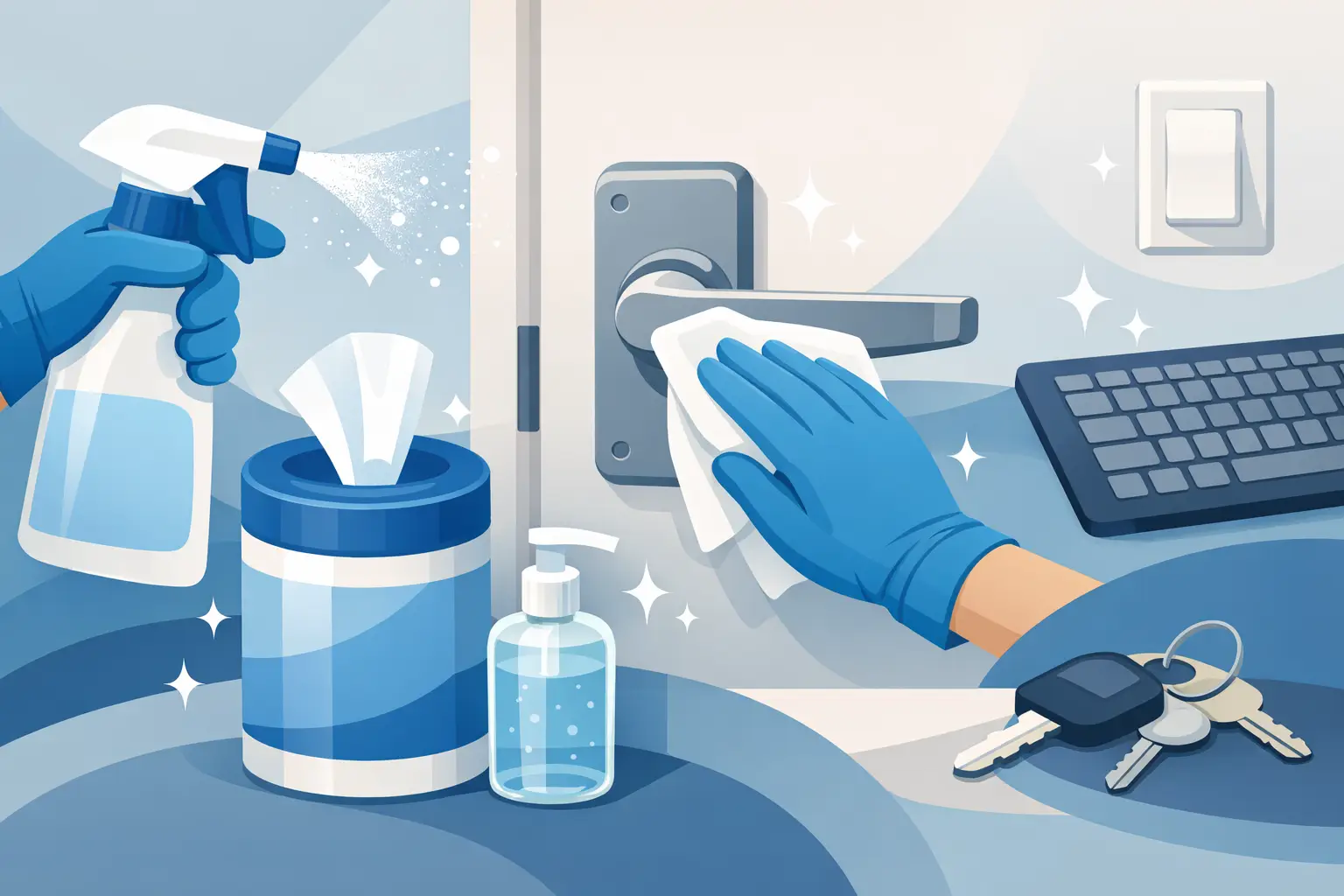

When a facility starts seeing more sick calls, customer complaints, or failed inspection details, high-touch surfaces are often part of the problem. Knowing how to sanitize high touch surfaces correctly is not just a housekeeping issue. It affects workplace health, public confidence, and day-to-day operations.
In commercial environments, these surfaces collect constant hand contact throughout the day. Door handles, push plates, elevator buttons, reception counters, light switches, shared desks, breakroom appliances, restroom fixtures, and payment terminals all create repeated opportunities for cross-contamination. In busier settings such as clinics, schools, gyms, restaurants, and multi-tenant properties, the risk increases because use is more frequent and the user base changes constantly.
What counts as a high-touch surface
A high-touch surface is any point that multiple people handle regularly during normal operations. Some are obvious, like faucets and handrails. Others are easier to overlook, including copier touchscreens, vending machine buttons, chair arms in waiting areas, door frames near latch points, shared tablets, and locker handles.
The right list depends on the facility. In an office, conference room tables, shared keyboards, and kitchenette surfaces may need closer attention. In a daycare, cubby handles, play tables, and restroom partitions matter more. In a warehouse or industrial setting, time clocks, machine controls, pallet jack handles, and breakroom seating may be the true touch points driving exposure.
That is why a facility-specific cleaning plan works better than a generic checklist. Sanitizing the wrong surfaces too often wastes labor. Missing the right ones creates avoidable risk.
How to sanitize high touch surfaces the right way
Sanitizing is not the same as wiping something down quickly. The process matters because product performance depends on surface condition, dwell time, and safe application. If any of those steps are skipped, the result may look clean without actually meeting sanitation expectations.
Start with cleaning, not just product application
If a surface has visible dirt, grease, residue, or spills, sanitize only after it has been cleaned. Soil can interfere with a sanitizer or disinfectant and reduce effectiveness. This is especially common in breakrooms, restrooms, gyms, food service areas, and industrial spaces where surfaces pick up oils, dust, or heavy traffic residue.
For example, a touchpoint like a refrigerator handle in a staff kitchen may need only a direct sanitizing step if it is visibly clean. A restroom door plate or shared table with residue usually needs cleaning first. Treating every surface the same is rarely efficient.
Use the right product for the setting
Not every facility requires the same chemistry. Offices and retail spaces may be well served by general EPA-registered sanitizing or disinfecting products appropriate for hard nonporous surfaces. Medical environments, child-focused facilities, and food-adjacent spaces often require more specific product selection based on regulations, occupant sensitivity, or exposure risk.
It also matters whether the goal is routine sanitizing or a higher level of disinfection. Sanitizing reduces bacteria to acceptable levels on suitable surfaces. Disinfection targets a broader range of pathogens, but usually comes with stricter label directions and contact times. In practice, many facilities need both, depending on the area and use case.
Follow dwell time exactly
One of the most common failures in high-touch surface care is removing the product too quickly. Most sanitizers and disinfectants require a surface to remain visibly wet for a set amount of time. If staff spray and wipe immediately, the chemical may not perform as intended.
This is where training and process discipline matter. Product labels are operational instructions, not suggestions. For facility managers, this is also a quality-control issue. If a contractor or in-house team cannot explain dwell time, there is a gap in execution.
Use clean tools and avoid cross-contamination
A sanitizer is only part of the system. If wipes, cloths, or mop heads are already contaminated, they can spread soils and microbes from one area to another. Color-coded microfiber systems, controlled cloth rotation, and clean-to-dirty workflows help reduce that risk.
This is especially important in restrooms, lunchrooms, medical spaces, and schools. The same cloth should not move from a restroom fixture to a door handle in a hallway. The process has to protect the building, not just check a box.
Frequency depends on traffic and facility type
There is no single schedule that fits every building. The right frequency depends on occupancy, public access, shift patterns, and the type of activity taking place. A private office with limited visitors does not need the same touchpoint schedule as a busy clinic, fitness center, or daycare.
High-traffic public and shared areas usually need more than once-daily attention. Restrooms, entrances, elevator lobbies, reception areas, and shared breakrooms often require multiple service intervals during operating hours. In lower-traffic administrative spaces, once daily may be enough if supported by regular maintenance and good hand hygiene practices.
If a facility is seeing recurring illness concerns, visible buildup on contact points, or complaints from staff and visitors, that is a sign the frequency should be reviewed. Seasonal illness periods, special events, and tenant turnover can also justify temporary increases.
Common high-touch sanitation mistakes
Many sanitation gaps are not caused by poor intentions. They come from inconsistent systems.
One common issue is relying on appearance alone. A polished counter or clean-looking door handle may still need proper sanitizing based on use. Another is overusing strong disinfectants on every surface, every time. That can create material damage, odor concerns, or unnecessary chemical exposure without improving outcomes.
Facilities also run into trouble when they fail to document touchpoint routines. In regulated or shared-use environments, documentation supports accountability. Without it, it becomes harder to verify whether service was completed at the right intervals and according to instructions.
Another problem is failing to match the method to the surface. Electronics, soft-touch materials, painted finishes, and specialty equipment may require approved techniques to prevent damage. A practical sanitation program protects both hygiene standards and building assets.
Facility-specific examples
In office settings, focus should usually center on entry hardware, elevator controls, shared meeting spaces, kitchen touchpoints, and restrooms. Hybrid workplaces can be tricky because hot desks and rotating occupancy create changing exposure patterns.
In medical and dental offices, front-desk counters, waiting room chairs, pens, exam room contact points, and restroom fixtures all deserve closer control. The process often needs stronger protocol discipline because public expectations and compliance requirements are higher.
In schools and daycares, the challenge is volume and repetition. Children touch everything, often without strong hygiene habits. Frequent attention to desks, cubbies, faucet handles, door hardware, and shared play surfaces is usually necessary throughout the day.
In gyms, member-facing equipment and locker room touchpoints drive the schedule. In warehouses and industrial buildings, sanitation often needs to follow operational traffic rather than customer traffic, with special focus on shared tools, control panels, break areas, and timekeeping devices.
Building a workable sanitation routine
The best sanitation program is one that your facility can sustain consistently. That means identifying the true high-touch surfaces, assigning realistic service frequencies, selecting approved products, and making sure staff are trained on sequence and contact time.
For many businesses, after-hours cleaning handles baseline sanitizing well, but daytime porter support is what keeps high-touch surfaces under control during active operations. That combination is often the best fit for larger offices, schools, medical spaces, fitness facilities, and multi-tenant properties where traffic continues long after the morning clean is complete.
It is also worth reviewing whether your current provider is sanitizing with purpose or simply wiping visible areas. A professional program should reflect how the building is actually used, who occupies it, and where hygiene risks concentrate. That is the standard Pristine Maintenance and Services applies when supporting commercial facilities with customized cleaning programs.
When professional support makes sense
Some facilities can manage basic touchpoint sanitation internally. Others benefit from outsourced support because the building is too large, too busy, too regulated, or too operationally complex for an informal approach.
If your team is already stretched thin, assigning sanitation to front-desk staff, teachers, managers, or maintenance personnel can create inconsistency. The work gets done when possible rather than when needed. In shared commercial environments, that usually leads to uneven results.
A trained cleaning partner can help standardize products, methods, scheduling, and reporting across the facility. That matters when you are responsible for staff wellbeing, tenant satisfaction, visitor experience, or compliance expectations.
Cleanliness is visible. Sanitation is procedural. The facilities that perform best over time are the ones that treat high-touch surfaces as part of operations, not an afterthought once the day gets busy.
0 Comments