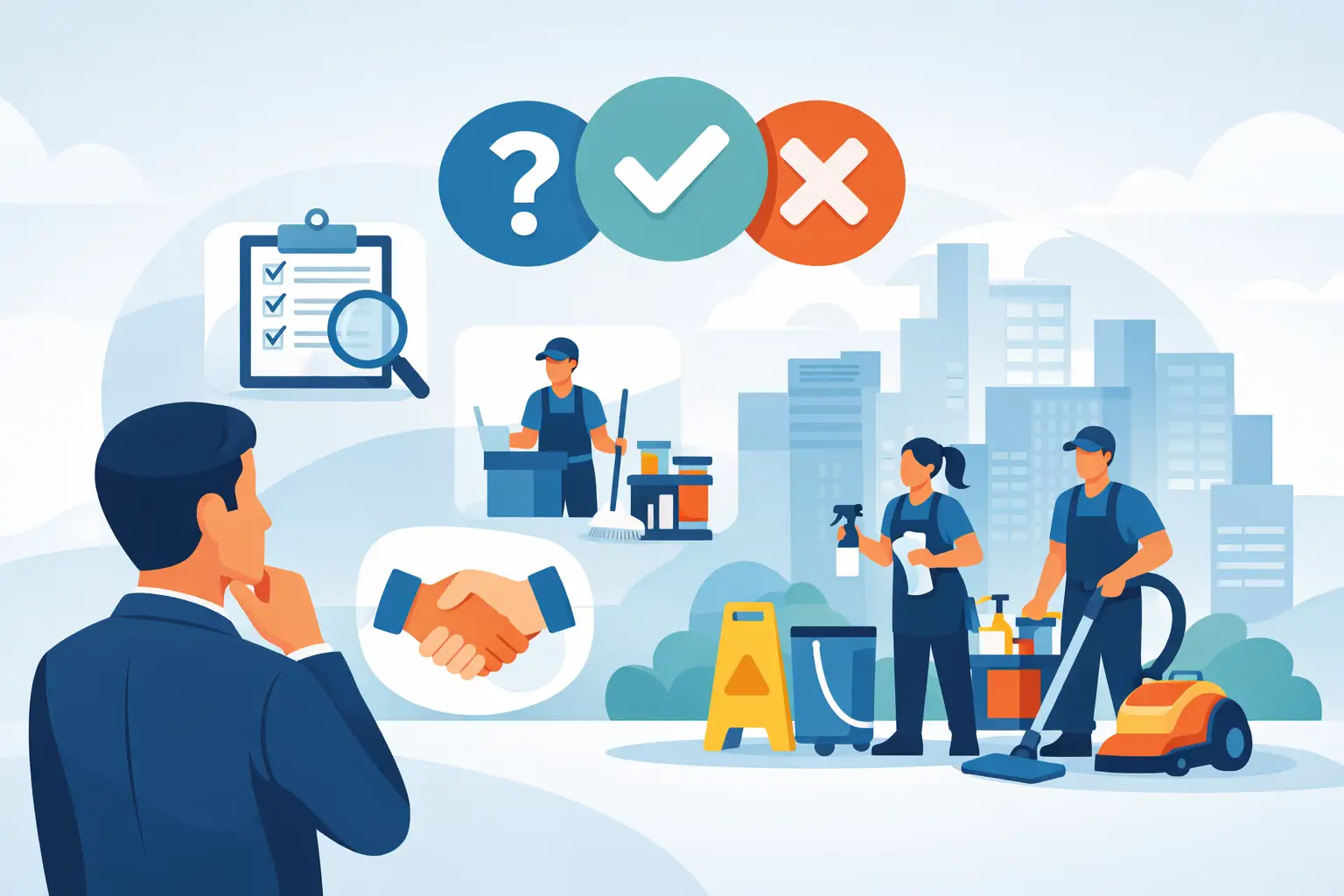

A missed trash pull, streaked lobby glass, or an empty soap dispenser usually tells you more about a janitorial vendor than a polished sales pitch ever will. If you are figuring out how to choose janitorial company support for your building, the real question is not who offers cleaning. It is who can protect your operations, your standards, and your reputation day after day.
For office managers, property managers, and facility leaders, janitorial service is not a cosmetic purchase. It affects tenant satisfaction, employee experience, health expectations, inspection readiness, and how your space functions after hours. That is why choosing the right provider requires more than comparing prices or checking who can start the fastest.
How to choose janitorial company support for your facility
The best place to start is with your building, not the vendor. A medical clinic, warehouse, daycare, and corporate office may all need routine cleaning, but the required methods, schedules, and risk levels are very different. If a company talks in generic terms about “full service cleaning” without asking detailed questions about your facility type, traffic patterns, restrooms, touchpoints, waste handling, or operating hours, that is a warning sign.
A qualified janitorial partner should want to understand how your space actually works. That includes when people arrive, which areas get heavy use, what surfaces need special care, and whether there are any sanitation, safety, or compliance concerns. In many buildings, cleaning has to happen around production schedules, tenant access, school hours, or customer-facing operations. A provider that cannot adapt to those realities will create friction no matter how competitive the quote looks.
This is where customized scope matters. Some facilities need nightly porter support and restroom attention. Others need detailed floor care, periodic disinfection, or cleaning protocols for sensitive environments. One-size-fits-all packages often sound efficient, but they tend to leave gaps in buildings with real operational demands.
Look beyond price and compare scope
Every buyer has a budget. That is reasonable. But janitorial proposals are only comparable when the scope is comparable.
A low bid may exclude consumable checks, touchpoint disinfection, breakroom cleaning, interior glass, daytime support, or periodic deep cleaning. Another quote may include all of it, plus supervision and documented quality control. On paper, one company looks cheaper. In practice, you may simply be buying less service.
Ask vendors to define exactly what is included, how often each task is performed, and what is considered extra. Frequency matters as much as the task itself. Vacuuming a high-traffic entrance twice a week is not the same as doing it nightly. Restroom sanitizing once a day is not the same as checking supplies throughout the shift.
It also helps to ask how the company handles special requests. Spills, weather-related mess, event cleanup, and seasonal demands are common in commercial facilities. A contract that looks simple at the start can become frustrating if every adjustment turns into a billing dispute or a delay.
A detailed site assessment is a good sign
Serious janitorial companies usually want to walk the site before pricing. That is not a sales formality. It is how they build an accurate scope, staffing plan, and schedule.
If a vendor gives a firm number with little or no understanding of your building, you should question how that price was built. Inaccurate estimating often leads to understaffing, inconsistent performance, and renegotiation later.
Evaluate training, supervision, and accountability
A janitorial company is only as reliable as the people and systems behind the service. This is especially important in larger buildings, regulated environments, and properties where access, security, and hygiene matter.
Ask how staff are trained. That should include task procedures, product handling, safe chemical use, cross-contamination prevention, and building-specific expectations. In some environments, such as medical offices, schools, daycares, and food-related spaces, the margin for error is smaller. You need a provider that understands the difference between cleaning for appearance and cleaning for hygiene.
Supervision is just as important as training. Some vendors place staff on-site and disappear until the invoice goes out. Others have active inspections, communication logs, area checklists, and working supervisors who catch issues early. The second model usually produces more consistent results.
Accountability should also be clear. Who is your point of contact? How are issues reported? What is the response time if there is a service problem after hours? If a company cannot explain its communication process, you may spend too much time chasing routine corrections.
Verify insurance, compliance, and risk controls
When you bring a janitorial vendor into your building, you are also bringing in operational risk. That makes insurance and compliance more than a box to check.
At minimum, a commercial janitorial company should be properly insured and able to provide proof of coverage. Depending on your facility, you may also need to ask about worker classification, background checks, WHMIS or equivalent safety training, site-specific safety procedures, and incident reporting. For properties with multiple tenants or public access, this matters even more.
It is also smart to ask about product selection and equipment use. Not every facility can tolerate the same chemicals, fragrances, or floor care methods. A good vendor should be able to explain how products are chosen based on surface type, occupancy, and sanitation requirements.
For decision-makers in schools, healthcare-adjacent settings, gyms, and food-service environments, this conversation should be specific. General answers are not enough. You want to hear how the company reduces cross-contamination, handles high-touch points, manages restroom sanitation, and supports a safer environment for occupants.
Ask how the company handles your type of facility
Experience in commercial cleaning is helpful, but relevant experience is better. A janitorial company that mainly services small offices may not be the right fit for a warehouse, manufacturing site, or multi-tenant property. The opposite is true as well. Industrial experience does not automatically translate to front-facing spaces where presentation and detail are closely noticed.
When considering how to choose janitorial company partners, look for evidence that the vendor understands the pace, risks, and expectations of your environment. Ask what similar facilities they support and what challenges are common in those spaces. Their answers should sound practical, not scripted.
For example, an office environment may require discreet after-hours service, consistent restroom presentation, and attention to conference rooms and touchpoints. A daycare or school may require stricter sanitation routines and safe product practices. A warehouse may need dust control, breakroom cleaning, and floor maintenance that works around operations. A condominium may involve common-area appearance, resident sensitivity, and reliable communication with property management.
A company that understands those differences will usually ask better questions and build a better plan.
Pay attention to responsiveness before you sign
The sales process often predicts the service experience. If communication is slow, vague, or inconsistent while the company is trying to win your business, it rarely improves once the contract starts.
Notice whether the vendor follows through, answers directly, and provides clear documentation. Are they punctual for walkthroughs? Do they send a proposal that reflects your actual building rather than a generic template? Do they explain what the startup process looks like?
Responsiveness matters because cleaning issues do not always happen on a convenient schedule. Weather, staffing changes, tenant complaints, and unexpected events require a partner that can adapt quickly. For many businesses, after-hours support is not a bonus. It is necessary to avoid disrupting staff, customers, patients, or residents.
Know what a strong janitorial proposal should include
A useful proposal should do more than list a monthly rate. It should describe the service scope, task frequencies, staffing assumptions, schedule, quality control approach, and any exclusions. It should also identify who manages the account and how service escalations are handled.
This level of detail protects both sides. It reduces confusion, sets performance expectations, and makes it easier to measure whether the service is working. Providers like Pristine Maintenance and Services build facility-specific programs for that reason. Buildings run better when cleaning is aligned with how the site operates, not forced into a generic package.
Be cautious with proposals that are too broad. Ambiguity may feel flexible at first, but it often leads to service gaps later.
Choose the company you can manage long term
The right janitorial partner is not always the cheapest or the largest. It is the company that can consistently execute in your environment with the right level of communication, supervision, and flexibility.
That means weighing trade-offs. A smaller provider may offer more direct communication but have less depth for emergencies. A larger company may have more coverage but feel less tailored. A very detailed scope may cost more upfront, yet reduce complaints and corrective work over time. It depends on your building, your risk tolerance, and how much oversight you want to carry internally.
A clean facility should not require constant follow-up from your team. The right janitorial company makes the building easier to run, not harder. If a vendor understands your space, defines the work clearly, and shows you how they will maintain standards consistently, you are probably looking in the right direction.
Choose the company that treats cleaning as part of your operation, because that is exactly what it is.

0 Comments