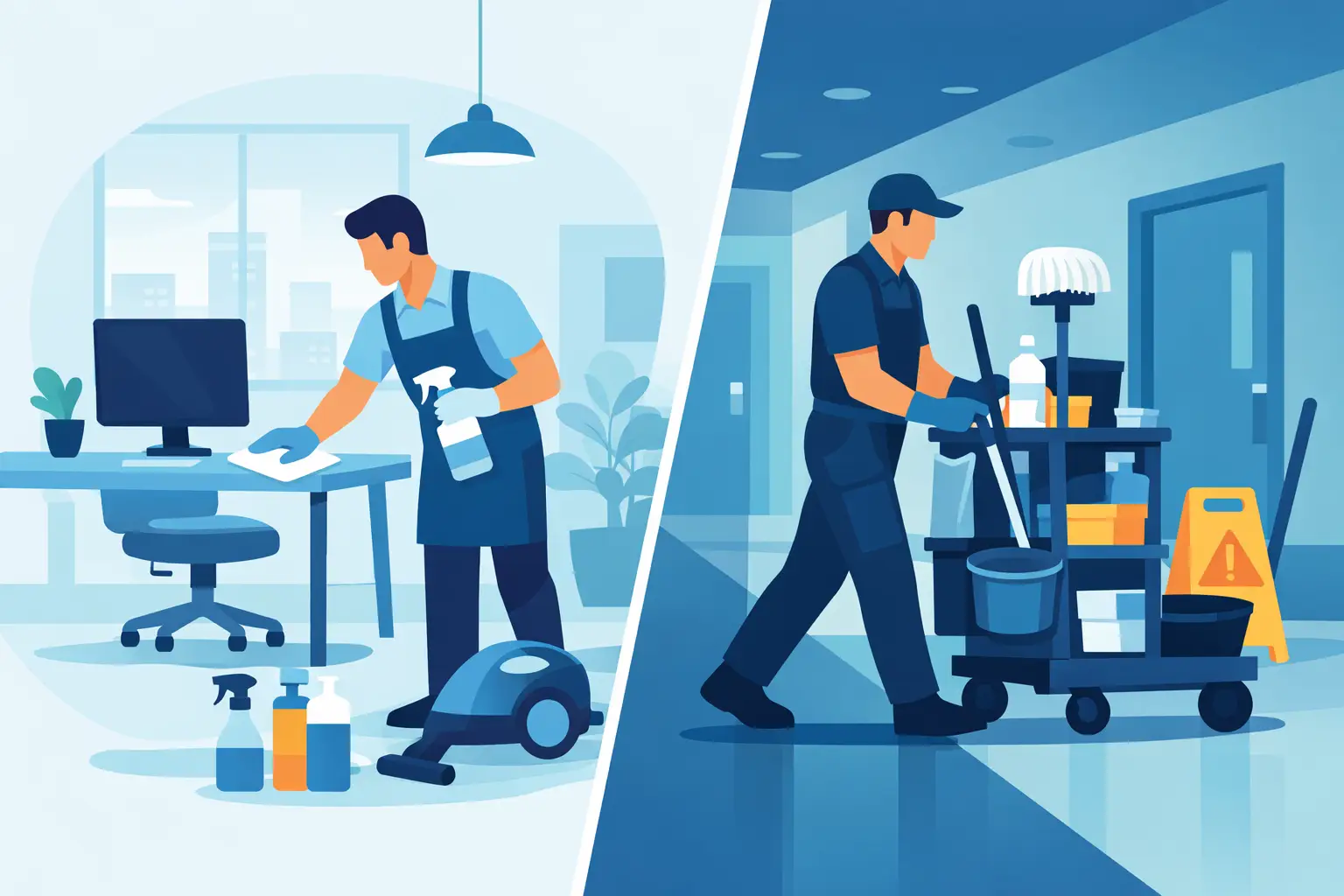

A clean office can look presentable at 8:00 a.m. and still fall short of the support a busy facility needs by midday. Restrooms need attention, waste accumulates, touchpoints require routine disinfection, and supplies run out. That is why the office cleaning vs janitorial question matters: the terms are often used interchangeably, but the service scope, schedule, and level of accountability can be very different.
For office administrators, property managers, and operations leaders, the better choice is not simply the service with the lowest quoted price. It is the one that matches how your facility operates, who uses it, and what standards you need maintained every day.
Office Cleaning vs Janitorial: The Core Difference
Office cleaning generally describes cleaning performed within an office environment. It may be a one-time service, a recurring evening visit, or a limited package focused on visible areas. Typical work includes vacuuming, dusting, cleaning restrooms and break rooms, removing trash, wiping desks, and mopping hard floors.
Janitorial service usually refers to an ongoing facility-maintenance program. Cleaning is still central to the work, but the service is organized around keeping the building consistently functional, sanitary, and presentable. A janitorial program may include daily or multiple-times-per-day restroom service, waste and recycling management, consumable supply monitoring, touchpoint disinfection, spill response, floor care coordination, and detailed reporting or quality checks.
The terms overlap considerably. Some providers call their recurring office work “office cleaning,” while others call the same work “janitorial service.” The label alone should not drive the decision. The written scope of work, frequency, staffing plan, and inspection process tell you what you are actually buying.
When Office Cleaning Is the Right Fit
Office cleaning is often appropriate for a smaller or lower-traffic workplace that needs dependable cleaning outside business hours. A professional office with a stable employee count, limited visitor traffic, and a standard Monday-through-Friday schedule may only need service two or three evenings per week.
In that setting, the priority is usually maintaining a clean appearance and a hygienic baseline without paying for daytime coverage that is unlikely to be used. The provider can empty waste, clean restrooms and kitchen areas, vacuum carpets, mop floors, wipe common surfaces, and address periodic detail work according to an agreed schedule.
Office cleaning can also work well when a facility already has on-site staff handling light daily tasks. For example, a receptionist or building attendant may replenish basic supplies and notify the cleaning provider when issues arise, while the cleaning crew completes the more thorough work after hours.
That said, a basic office cleaning arrangement can become inadequate when traffic increases, tenants share common areas, or hygiene requirements become more demanding. If restrooms are used heavily throughout the day or garbage must be removed before evening, the business may need a janitorial program rather than a standard nightly clean.
When Janitorial Service Makes More Sense
Janitorial service is built for facilities where cleanliness is an operational requirement, not just an end-of-day task. This commonly includes multi-tenant commercial properties, medical clinics, schools, daycares, gyms, retail spaces, restaurants, warehouses, and industrial facilities.
These environments create recurring needs that cannot always wait until closing time. A clinic may require frequent cleaning of patient areas and high-touch surfaces. A warehouse may need consistent restroom maintenance and break-room cleaning across multiple shifts. A condominium may need lobbies, elevators, corridors, and garbage areas maintained on a set routine. In each case, the work is broader than a standard office checklist.
A janitorial provider can schedule service around the facility’s actual rhythm. That may mean overnight cleaning, early-morning service before staff arrive, daytime porter coverage, or a combination of all three. The program can also define response expectations for spills, unexpected messes, supply shortages, and high-traffic events.
The advantage is consistency. Rather than relying on a crew to complete a generic list, the facility receives a structured maintenance plan with defined tasks, frequencies, and accountability.
Compare the Scope, Not the Service Name
When evaluating office cleaning vs janitorial services, ask providers to explain exactly what happens during each visit. A quote that says “clean restrooms” may mean a quick wipe-down once per evening, or it may include multiple inspections, disinfection, replenishment of paper products, and attention to floors, partitions, fixtures, and odor control. Those are not equivalent services.
A useful scope should identify the areas covered, the tasks completed, and how often each task occurs. Daily work might include trash removal, restroom cleaning, break-room sanitation, vacuuming entrance areas, and disinfecting frequently touched surfaces. Weekly or monthly work may cover detailed dusting, baseboards, interior glass, carpet spot treatment, machine floor care, or high dusting.
It should also clarify exclusions. Window exteriors, post-construction cleanup, biohazard response, deep carpet extraction, and specialized floor restoration may require separate scheduling and pricing. Clear boundaries prevent frustration later, especially when building conditions change.
Frequency Is Often the Deciding Factor
The most meaningful difference between a limited office cleaning plan and janitorial maintenance is often frequency. A five-person office with one restroom may be well served by twice-weekly cleaning. A 50-person office with daily visitors, shared kitchens, and several restrooms may need nightly service. A public-facing facility may need cleaning attention during the day as well.
Consider what happens between scheduled visits. If trash overflows, restrooms become unacceptable, or common areas quickly lose their professional appearance, the schedule is too light. If the workspace stays orderly and supplies remain available, a less frequent plan may be sufficient.
Traffic patterns matter as much as square footage. A modest clinic reception area can require more attention than a larger private office because patients, visitors, and staff use it continuously. Similarly, a warehouse with limited office space may still require a more involved program due to shift schedules, dust, washroom use, and safety expectations.
Hygiene Standards and Facility Risk
Every facility needs a clean environment, but not every facility has the same sanitation risk. An office may primarily need routine disinfection of touchpoints, kitchen surfaces, and restrooms. A daycare, medical practice, food-service business, or fitness center has greater exposure to high-touch surfaces, bodily fluids, shared equipment, or stricter sanitation expectations.
For these sites, a janitorial program should include appropriate cleaning methods, trained staff, safe chemical use, and procedures for handling issues promptly. The service provider should understand which surfaces need cleaning, which need disinfection, and how to avoid cross-contamination between restrooms, food areas, treatment rooms, and general spaces.
High hygiene standards are not achieved by adding vague promises to a contract. They come from clear procedures, adequate visit frequency, proper supplies, staff training, and routine quality control.
Cost: Look Beyond the Monthly Quote
Office cleaning may appear less expensive because it is often scheduled less frequently and includes fewer tasks. That can be the right financial choice for a low-traffic office. Paying for daily maintenance that your space does not need is not efficient.
However, a lower quote can create higher costs when the scope does not match the building. Poorly maintained restrooms, overflowing waste, missed touchpoints, and neglected floors affect employee experience, visitor confidence, and the condition of the property. Frequent complaints also pull office managers and maintenance teams away from their own responsibilities.
Compare proposals based on service hours, visit frequency, covered areas, staffing, supplies, supervision, and response procedures. If one provider includes consumables or periodic floor care and another does not, the apparent price difference may not reflect the real value of the service.
Questions to Ask Before You Choose
Before signing a cleaning agreement, confirm whether the provider can adapt to your building and schedule. Ask how tasks are documented, how quality issues are reported and corrected, whether staff are trained and insured, and what happens when a cleaner is unavailable. For sensitive facilities, ask about disinfection practices, cleaning products, and experience in comparable environments.
It is also worth discussing growth. A service plan that works for a small office today may need adjustment after a move, staffing increase, new tenant, extended operating hours, or change in facility use. A dependable provider should be able to revise the scope without forcing you into a generic package.
For businesses across Toronto and the GTA, Pristine Maintenance and Services develops cleaning programs around the realities of each facility, including after-hours schedules and specialized hygiene needs. The goal is not to assign a label to the work. It is to maintain a space that supports employees, visitors, tenants, and daily operations.
The practical choice is simple: select office cleaning when your needs are limited and predictable; select janitorial maintenance when your facility requires ongoing oversight, flexibility, and a more detailed standard of care. Start with how your space is used, then build the service around it.



0 Comments