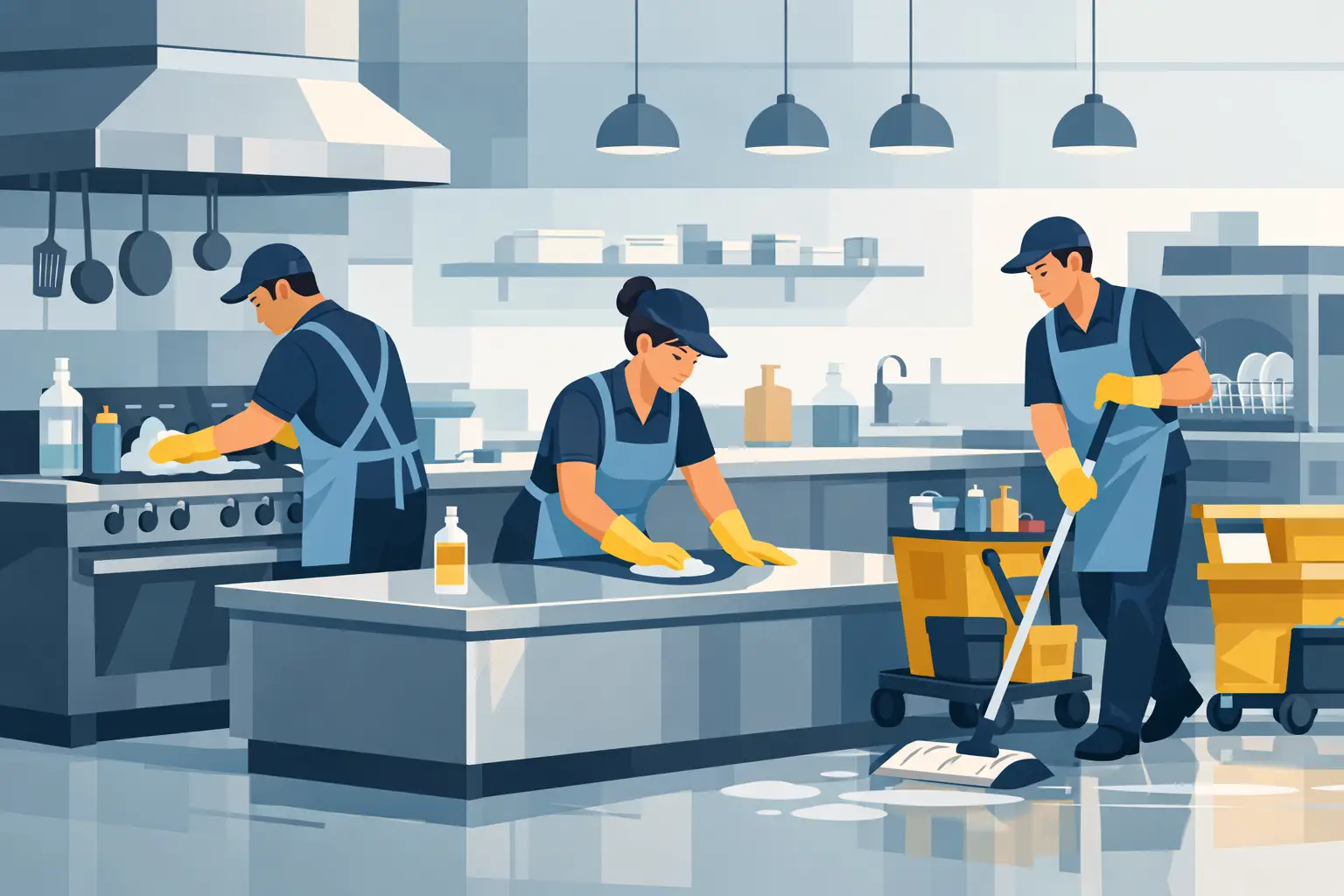

The lunch rush leaves a visible mess. The real problem is everything it leaves behind that staff cannot fully address between prep, service, closing, and the next day’s delivery window. Restaurant kitchen cleaning services are built for that gap – the work that goes beyond routine wipe-downs and helps keep a food operation safe, inspection-ready, and easier to run.
For restaurant owners, operators, and facility managers, kitchen cleaning is not just about appearance. It affects food safety, staff efficiency, equipment performance, odor control, pest prevention, and the overall condition of the space. When cleaning falls behind, the impact usually shows up fast: grease buildup around cooking lines, residue under equipment, slippery floors, dirty vents, neglected drains, and recurring sanitation concerns that internal teams do not always have the time or tools to solve.
What restaurant kitchen cleaning services actually cover
A commercial restaurant kitchen needs more than end-of-shift cleaning. Daily staff routines are essential, but they are usually focused on immediate operational tasks such as wiping prep tables, washing smallwares, taking out trash, and resetting stations. Professional restaurant kitchen cleaning services are designed to handle the deeper, more technical cleaning work that supports a safer environment over time.
That often includes degreasing high-heat cooking areas, cleaning behind and beneath equipment, detailed floor scrubbing, wall and backsplash cleaning, drain cleaning, and attention to surfaces where grease and food residue build up gradually. In many cases, service also extends to walk-in cooler floors, storage shelving, dishwashing areas, and trash handling zones where moisture and organic waste create sanitation risks.
The exact scope depends on the operation. A quick-service restaurant with extended fryer use has different needs than a fine dining kitchen or a school cafeteria. A one-size-fits-all approach usually misses the mark because equipment layouts, production volume, menu type, and hours of operation all shape what cleaning should look like.
Why restaurant kitchen cleaning services matter beyond appearances
The most obvious benefit is cleanliness, but that is not the main reason many operators bring in outside support. They do it because kitchen sanitation directly affects risk.
Grease accumulation is one of the clearest examples. It builds on floors, equipment exteriors, walls, and harder-to-reach surfaces. Left alone, it creates slip hazards, contributes to odors, and makes regular maintenance harder. It can also shorten the life of finishes and equipment surfaces that are constantly exposed to heat and residue.
Then there is cross-contamination risk. Even in a well-managed kitchen, high-volume production creates pressure. Staff move quickly, stations turn over fast, and certain cleaning tasks get delayed because they take too long during operating hours. Deep cleaning support helps close those gaps and maintain a more controlled environment.
There is also the practical issue of inspections. Health inspections do not only look at what is visible at eye level. Inspectors pay attention to buildup in overlooked areas, sanitation practices, and whether the facility shows signs of ongoing control rather than last-minute cleanup. Professional cleaning helps create that consistency.
The difference between staff cleaning and professional service
Internal teams should handle daily sanitation responsibilities. That part does not change. The challenge is that kitchen staff are hired primarily to prep, cook, serve, manage inventory, and close the line. Expecting them to complete full-scale deep cleaning on a recurring basis often leads to uneven results.
This is where restaurant kitchen cleaning services make operational sense. A trained commercial cleaning team can work around equipment, degrease problem areas properly, and follow a scope built around the actual condition of the kitchen. They also bring a level of consistency that is difficult to maintain when cleaning is added to an already demanding shift.
That does not mean every restaurant needs the same frequency. Some kitchens need multiple service visits per month, especially if they run long hours, cook with heavy grease, or serve high customer volume. Others may need scheduled deep cleaning at a lower frequency supported by strong daily internal routines. It depends on output, layout, staffing, and the condition of the facility.
Areas that are commonly missed in busy kitchens
Most problem areas are not dramatic. They are simply easy to postpone.
The spaces under line equipment often collect grease, crumbs, moisture, and debris that can become a sanitation and pest issue if ignored. Floor edges and grout lines can hold residue long after the visible surface has been mopped. Splash zones behind cooking equipment may look manageable from a distance while carrying layers of buildup up close.
Drains are another frequent concern. They deal with constant runoff, food particles, and grease exposure. If they are not cleaned properly, they can contribute to odors and bacterial growth. Storage areas can also become neglected, especially when staff focus their time on front-line production spaces.
A professional cleaning program is useful because it accounts for these less visible areas instead of focusing only on what customers or managers see first.
Choosing restaurant kitchen cleaning services for your operation
Not every commercial cleaning vendor is a strong fit for food service. Restaurant kitchens require more than general janitorial experience. The provider should understand sanitation expectations, work safely around food environments, and build a cleaning plan that fits your operating schedule.
That usually starts with a site review. A serious provider will want to understand your kitchen layout, traffic patterns, production volume, and problem areas before recommending a schedule. They should also be clear about what is included, what requires special attention, and how service will be delivered without disrupting prep or service hours.
For many operators, after-hours availability matters just as much as cleaning quality. The kitchen has to be ready for the next shift. That means the work needs to be thorough, but it also needs to be completed on time, with clear communication and minimal operational disruption.
It is also reasonable to ask about staff training, insurance, supervision, and safe product use. In a kitchen environment, trust comes from dependable execution and a clear understanding of standards, not broad marketing claims.
What a customized cleaning plan should include
A useful plan is not built from a generic package. It should reflect the way your kitchen actually operates.
That means identifying high-grease areas, high-touch zones, moisture-prone surfaces, and spaces that internal staff do not consistently have time to address. It should also define service frequency based on need rather than assumption. A busy chain location may require a different cadence than an independent restaurant with shorter service hours.
The plan should also account for timing. Overnight or after-hours service is often the best option because it allows for more complete access to floors, cooking lines, prep areas, and dish stations. When cleaning teams can work without active food production around them, results are typically better and safer.
For businesses in the Toronto and GTA market, this operational approach is where experienced commercial providers such as Pristine Maintenance and Services can add value. The focus should be on facility-specific service, clear scope, and reliable scheduling rather than a generic kitchen cleaning checklist.
Signs it is time to bring in professional support
If your team is constantly catching up instead of staying ahead, that is usually the first sign. Others are more visible: recurring grease on floors, persistent odors, staining around cooking areas, buildup in corners and along walls, or concerns raised during inspections and walkthroughs.
You may also notice indirect signs. Equipment becomes harder to clean. Closing takes longer. Staff spend more time addressing the same sanitation issues. Managers start relying on spot fixes instead of a planned routine. None of these issues mean your team is failing. More often, they mean the kitchen has outgrown what in-house cleaning alone can realistically cover.
Restaurant kitchen cleaning services work best when they are treated as part of operations, not an emergency response. With the right schedule and scope, they help protect standards, reduce avoidable risk, and give kitchen teams a cleaner environment to work in every day.
A well-run kitchen does not stay clean by accident. It stays clean because the cleaning program matches the pace, pressure, and demands of the operation.

0 Comments