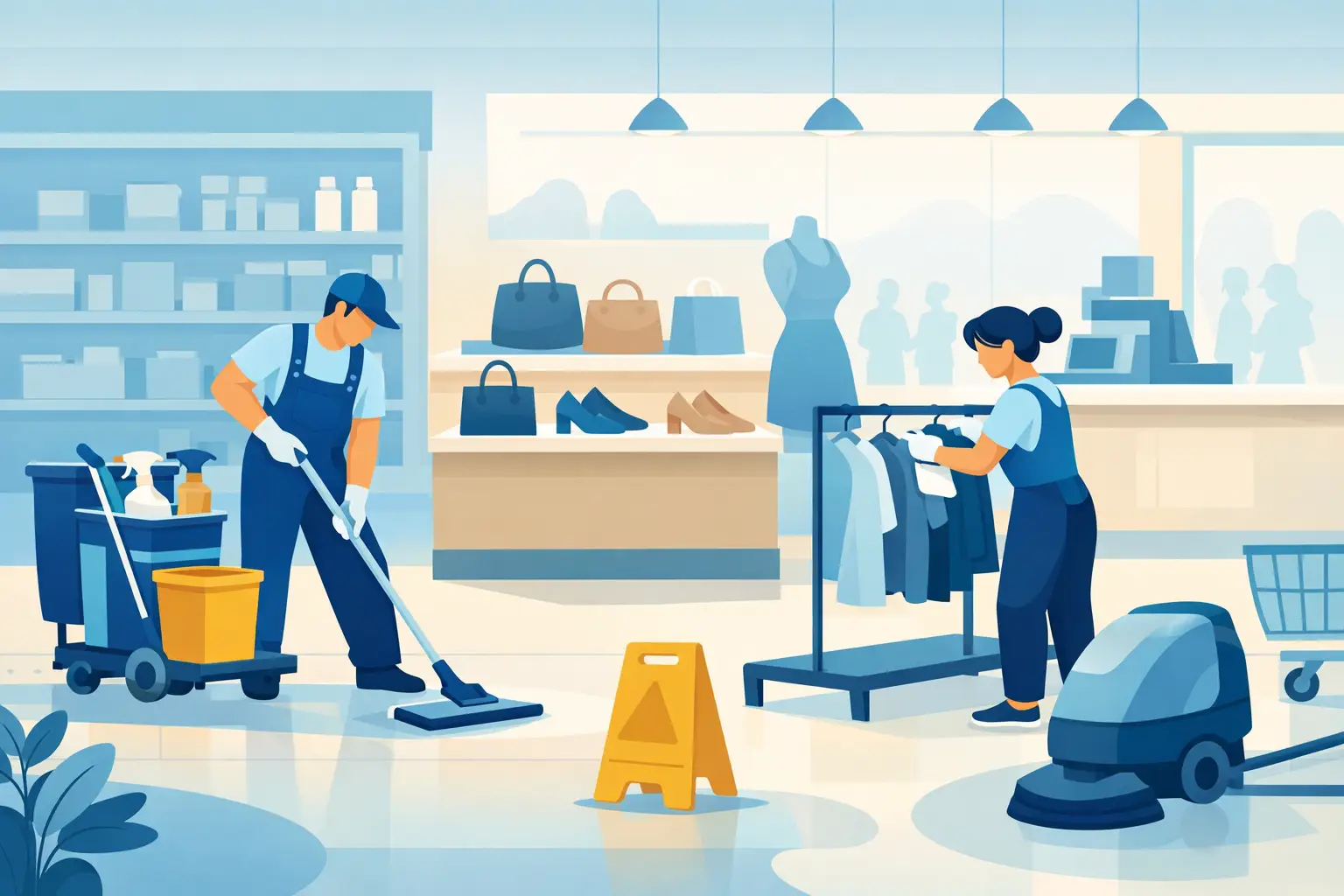

A retail floor can look fine at opening and worn down by noon. Fingerprints build up on glass, fitting rooms collect dust and tags, restrooms need attention, and entryways track in everything the weather brings. That is why retail store cleaning services need to be built around traffic patterns, store hours, and presentation standards – not generic cleaning routines.
For store owners, operations managers, and property teams, cleaning is not only about appearance. It affects customer perception, employee working conditions, safety, and day-to-day execution. A missed restroom check, dusty shelf edge, or neglected spill response can create problems that are visible to shoppers and costly for the business.
What retail store cleaning services actually need to cover
Retail environments are more complex than they look from the sales floor. A cleaning program has to support front-of-house presentation while also addressing the back areas that affect operations. That usually includes entrances, sales floors, checkout zones, fitting rooms, restrooms, break rooms, stockrooms, and staff corridors.
Each of those spaces has a different cleaning requirement. Entrance glass and doors show smudges quickly and often need frequent touchpoint attention. Sales floors need debris removal, spot treatment, and floor care that fits the surface type. Fitting rooms require regular reset and sanitation because of close customer contact. Stockrooms may not be customer-facing, but they still need dust control, waste handling, and safe walking surfaces.
Retail cleaning also depends on the type of store. A boutique apparel location, a grocery format, a pharmacy, and a large-format retailer do not create the same mess or carry the same sanitation expectations. That is where one-size-fits-all cleaning plans usually fall short.
Why scheduling matters as much as cleaning quality
Retail stores operate on customer hours, delivery schedules, merchandising resets, and staffing constraints. A cleaning provider has to work around those realities. In many cases, after-hours service is the most practical option because it allows the store to be cleaned thoroughly without interrupting sales activity.
That said, after-hours service is not the answer for every location. Some stores benefit from daytime porter support, especially in malls, high-traffic street retail, or stores with heavy restroom and fitting room use. Others only need evening janitorial service with periodic deep cleaning. The right schedule depends on traffic volume, store size, and brand presentation standards.
A dependable provider should be able to define what needs daily attention, what can be handled several times a week, and what belongs on a less frequent floor or detail schedule. That balance controls cost while keeping standards consistent.
High-touch surfaces are not a small detail
Retail customers notice shine and order, but they also notice whether a store feels clean. That feeling often comes from the areas people touch constantly – door pulls, checkout counters, payment terminals, fitting room benches, shopping baskets, handrails, and restroom fixtures.
These touchpoints need more than casual wipe-downs. They require a repeatable process, the right products, and attention to safe use in occupied commercial environments. In stores that handle high customer volume, seasonal rushes, or health-sensitive products, disinfection may also be part of the program.
There is an important distinction here. Not every store needs the same level of disinfection frequency, and over-servicing can waste budget. But under-servicing high-contact areas can affect both customer confidence and staff wellness. A good cleaning plan accounts for actual use, not assumptions.
Floor care carries most of the visual load
If a retail floor looks dull, streaked, or dirty, the entire store can feel neglected even when the shelves are organized. Floor care is usually the most visible part of retail cleaning, and it is one of the easiest places for standards to slip.
Different floor types need different methods. Hard surfaces may require dust mopping, damp mopping, auto-scrubbing, burnishing, or periodic refinishing. Carpeted areas need regular vacuuming and scheduled extraction to control soil and appearance. Entry mats need close attention because they protect the rest of the store from debris and moisture.
The trade-off is simple: aggressive floor care can improve appearance, but it has to be timed properly to avoid safety risks, odor issues, or disruption. A store that is open late or receives early deliveries may need a narrow service window. That is why scheduling and floor maintenance strategy should be planned together.
Restrooms, fitting rooms, and back rooms shape the full customer experience
Some areas carry more weight than their square footage suggests. Restrooms are an obvious example. Customers may only spend a few minutes there, but the condition of that space often influences how they judge the entire store. Clean fixtures, stocked supplies, odor control, and dry floors are baseline expectations.
Fitting rooms matter just as much in apparel and specialty retail. Dust accumulation, discarded tags, fingerprints on mirrors, and debris under benches can quickly make the space feel unmanaged. Since these rooms directly affect purchase decisions, they should be part of the core cleaning scope, not an afterthought.
Back rooms are different, but no less important. Stockrooms, receiving areas, and employee spaces influence safety, workflow, and morale. They often collect cardboard dust, shrink wrap debris, pallet fragments, and spills that are not visible to customers but still create risk for staff.
What to look for in a retail cleaning partner
Retail buyers usually are not looking for the lowest line item. They are looking for predictable execution. That means the cleaning company should have trained and insured staff, clear scope management, reliable attendance, and quality control that does not depend on constant client follow-up.
It also means the provider should understand how stores operate. Cleaning around fixtures, displays, electronics, point-of-sale equipment, and seasonal merchandising requires care. So does working within mall rules, security procedures, and opening deadlines.
A strong vendor relationship usually starts with a realistic scope. If the service plan is too broad for the budget, standards will erode. If it is too narrow, store teams end up filling the gaps. The better approach is to prioritize the areas that affect safety, sanitation, and presentation most, then build from there.
Customized retail store cleaning services deliver better results
The most effective retail store cleaning services are built for the site, not copied from another account. A neighborhood storefront with moderate traffic may need dependable evening service and periodic floor work. A multi-tenant retail location or flagship store may need a more detailed plan with daytime touch-ups, restroom checks, and frequent glass cleaning.
Customization also matters across seasons. Rain, snow, salt, pollen, and holiday traffic all change what the store needs. Entry maintenance may become the top issue in winter, while fingerprinting, dust, and restroom traffic may rise during peak sales periods. A static plan will not always keep up.
For businesses managing multiple locations, consistency matters just as much as flexibility. The service program should reflect each site’s layout and volume while still following a defined standard. That gives operations teams clearer oversight and fewer surprises.
Pristine Maintenance and Services approaches commercial cleaning this way – by aligning service scope with how the facility actually operates rather than forcing a generic package onto every environment.
When periodic deep cleaning makes sense
Daily service handles visible upkeep, but it does not replace periodic detail work. Retail spaces benefit from scheduled deep cleaning for floors, baseboards, vents, high dusting, fixtures, low walls, and neglected corners behind movable displays or shelving.
This is especially useful during season changes, before major promotions, after renovation work, or when a store is preparing for inspections or brand visits. Deep cleaning is not always needed every month, but waiting too long often makes routine cleaning less effective and more expensive to correct.
The right frequency depends on traffic, store layout, and brand expectations. A high-volume environment may need more frequent floor restoration and detail work than a smaller specialty location.
Cleaning that supports the business
Retail cleaning should make the store easier to run. It should reduce distractions for staff, support safer conditions, and help the space stay customer-ready without management having to chase basic tasks. That only happens when the scope, timing, and quality standards match the actual demands of the location.
A well-maintained store does not call attention to the cleaning behind it. Customers simply see a business that looks organized, cared for, and ready for them. For retail operators, that is the standard worth aiming for.

0 Comments