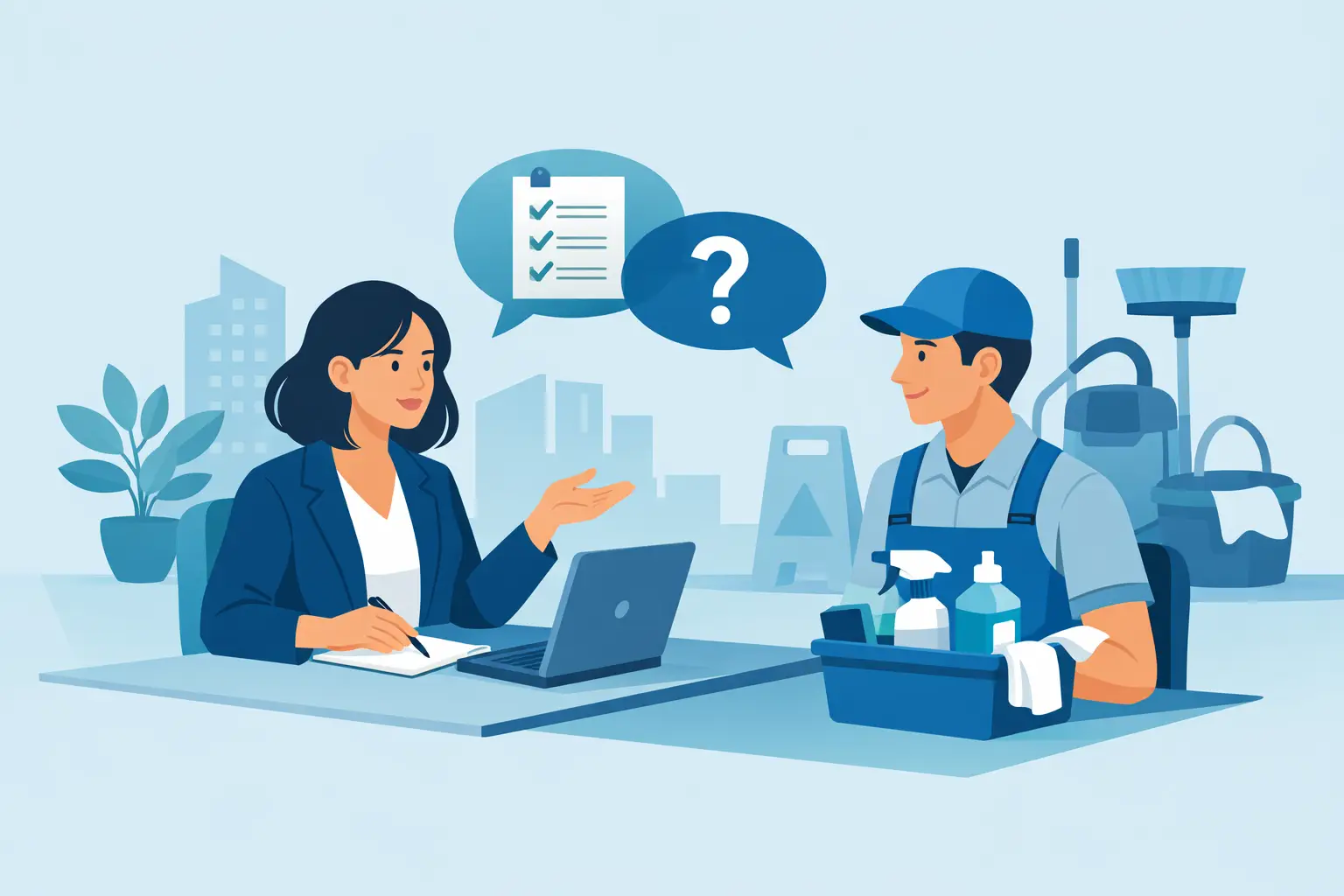

A low price can look good on paper right up until missed cleanings, inconsistent restroom sanitation, or after-hours access problems start affecting your staff and visitors. If you are deciding what to ask cleaning contractors, the goal is not simply to compare quotes. It is to find out whether a vendor can support your building, your schedule, and your standards without creating more work for your team.
For commercial facilities, the right questions reveal far more than a proposal ever will. They show how a contractor manages staffing, handles quality control, works in sensitive environments, and responds when something goes wrong. That matters whether you oversee an office, clinic, school, warehouse, condominium, gym, or retail location.
What to Ask Cleaning Contractors Before You Compare Price
Price matters, but it should come after scope, reliability, and operational fit. Two vendors can submit very different numbers because they are pricing very different service levels. One may include detailed restroom sanitation, touchpoint disinfection, floor care, and supervisor inspections. Another may only cover basic emptying and surface wiping.
Start by asking how they build their scope of work. A serious commercial cleaning contractor should be able to explain how they assess square footage, traffic levels, occupancy patterns, washroom use, break areas, floor types, and any health-sensitive or regulated requirements. If a company offers the same package to a law office, a daycare, and a manufacturing site, that is a warning sign. These environments do not carry the same cleaning risks or operational demands.
You should also ask what is included, what is optional, and what falls outside the base contract. This is where many service issues begin. If you expect interior glass, consumable checks, spot cleaning, or periodic deep cleaning, those details should be clearly defined from the start.
Questions That Reveal Operational Reliability
Commercial cleaning is an ongoing service, not a one-time purchase. That means execution matters more than presentation. Ask who will actually clean your facility, how teams are assigned, and what happens if a scheduled cleaner is absent. A dependable contractor should have backup coverage and a clear staffing process, not an improvised answer.
It is also worth asking whether work is performed by employees or subcontractors. There is not always one correct model, but there is a difference in control. If subcontractors are used, ask how training, supervision, accountability, and site security are managed. In many facilities, especially those with key access, alarm systems, or sensitive information, that distinction matters.
Response time is another practical issue. Ask how service requests, complaints, and urgent needs are handled after business hours. If your building operates early mornings, evenings, or weekends, you need to know whether support is actually available when problems happen. A contractor that serves commercial accounts should have a structured communication process, not just a general inbox and a hope for the best.
Ask About Training, Insurance, and Compliance
This is where experienced buyers separate qualified contractors from basic cleaning providers. Ask whether staff are trained for the specific environment they clean. An office suite, medical clinic, fitness center, and food-service area each require different procedures, products, and attention points.
Training should go beyond general cleaning technique. Ask about safe chemical handling, bloodborne pathogen awareness where relevant, cross-contamination prevention, restroom sanitation procedures, PPE use, and site-specific protocols. In schools, daycares, clinics, and high-touch public spaces, these details are part of risk management, not just housekeeping.
Insurance should be discussed directly, not assumed. Ask whether the contractor carries general liability coverage, workers’ compensation coverage, and bonding where applicable. If your building requires vendor compliance documents before access is granted, confirm that these can be provided promptly.
For certain facilities, compliance standards may also shape the conversation. Medical environments, child care settings, food-related businesses, and industrial sites may have sanitation, documentation, or safety expectations that exceed standard office cleaning. A contractor does not need to claim expertise in every sector, but they should be transparent about what they are equipped to support.
What to Ask Cleaning Contractors About Quality Control
A common problem in commercial cleaning is the gap between the sales conversation and the actual service experience. To avoid that, ask how quality is measured once the contract begins. If the answer is vague, expect inconsistency later.
A professional contractor should be able to explain their inspection process, supervisory check-ins, and methods for documenting service performance. Some use scheduled inspections. Others rely on account managers, digital reporting, site checklists, or client review meetings. The format may vary, but there should be a system behind it.
Ask how often supervisors visit your site and what happens when deficiencies are found. You are listening for accountability. A strong answer includes follow-up, retraining if needed, and communication with the client. A weak answer usually sounds like, “Call us if something comes up.” That puts the burden back on your team.
It also helps to ask how they manage consistency across multiple cleaners or shifts. This is especially relevant in large facilities, condominiums, schools, and distribution environments where more than one person may touch the site. Standardized site instructions and documented routines are often what keep service stable over time.
Ask About Scheduling and Site Access
Cleaning has to fit your operation, not disrupt it. Ask what schedules they can support and whether after-hours service is available. For many businesses, evening or overnight cleaning is the best option because it keeps public areas, workspaces, and tenant activity uninterrupted.
You should also discuss site access in practical terms. Ask how keys, fobs, alarm codes, restricted zones, elevators, loading docks, and sign-in procedures are handled. If your building has security requirements or access limitations, the contractor should be prepared to work within them without creating confusion.
Frequency is another area where a tailored approach matters. Daily service may be necessary for some facilities, while others need a hybrid schedule with recurring janitorial work plus periodic floor care or disinfection. A capable contractor should be willing to recommend a service plan based on actual traffic and use patterns, not push you into either more or less service than the building requires.
The Questions That Clarify Scope
Before signing anything, ask for a clear breakdown of tasks by frequency. Daily, weekly, monthly, and periodic items should not be blended into one broad promise to keep the facility clean. You want specifics.
For example, ask how restrooms are serviced, how breakrooms are handled, whether touchpoints are included, how floors are maintained, and what is covered in common areas versus private spaces. If you manage a multi-tenant or mixed-use property, clarify which zones fall under the contract and which do not. Misunderstandings here often show up as complaints later.
It is also smart to ask about supplies and equipment. Find out whether the contractor provides cleaning products, dispensers, liners, paper goods, or specialty equipment, and whether those costs are included in the proposal. Not every provider structures this the same way, so assumptions can become budget issues quickly.
When References and Experience Matter Most
Not every contractor needs to have served your exact building type, but they should understand the operational realities of similar facilities. Ask what kinds of properties they clean regularly and what challenges they solve in those environments.
This is especially important for health-sensitive, high-traffic, or regulated spaces. A contractor that performs well in standard office settings may not be the right fit for a medical clinic, daycare, industrial site, or restaurant. The issue is not prestige. It is whether they understand the pace, risk points, and sanitation expectations of your facility.
References can help, but ask better questions than simply whether clients are satisfied. Ask whether the contractor has experience onboarding multi-shift operations, handling urgent service adjustments, maintaining consistency across large sites, or supporting buildings with strict access and compliance requirements.
How to Listen to the Answers
Knowing what to ask cleaning contractors is only half the job. You also need to evaluate how they answer. Clear, direct responses usually signal process maturity. Evasive answers, broad claims, or pressure to move quickly often indicate gaps in staffing, supervision, or service structure.
Look for a contractor that speaks in terms of site conditions, staffing plans, communication channels, and measurable scope. Commercial cleaning should feel operationally organized from the first conversation. If it already feels unclear during quoting, it rarely becomes clearer after the contract starts.
For businesses and facilities that need dependable day-to-day support, the best contractor is rarely the one with the shortest proposal or the lowest number. It is the one that understands how cleaning affects safety, appearance, compliance, and daily operations – and can back that up with a service plan built for your space. At Pristine Maintenance and Services, that is exactly where the conversation should begin.


0 Comments